
Dianna Casteel Custom Knives
 Custom Flashlights and Torches
- 3LegDog Knives (1)
- 417CNC Knives (1)
- A2 Knives (1)
- Allen Elishewitz Custom Knives (3)
- André Thorburn Custom Knives (2)
- Andriy Mozil Custom Knives (2)
- Anton van der Westhuizen Custom Knives (1)
- Arno Bernard Knives (2)
- Bill Coffey Custom Knives (1)
- Bill Poor Custom Knives (1)
- Billy Mace Imel Custom Knives (2)
- Blackside Customs (5)
- Borka Blades & Sebastijan Berenji (2)
- Brandon Vallotton Custom Knives (2)
- Brian Milinski Custom Knives (1)
- Brian Tighe Custom Knives (1)
- Brown Knives by Craig Brown (3)
- Buddy Gaines Custom Knives (1)
- Burn Knives by Paul Panak (5)
- Chris Reeve Knives (12)
- Chuck Gedraitis Custom Knives (3)
- Clark Blades by David Clark (1)
- Corrie Schoeman Custom Knives (1)
- Curt Zimmermann Custom Knives (3)
- Curtiss Knives (1)
- Custom Knife Factory (CKF) (7)
- Darac Steel & Dario Zadravec (1)
- Daryl Hibben Custom Knives (1)
- David Broadwell Custom Knives (2)
- DDR Knives - Darrel Ralph (2)
- Dervish Knives - John Gonzalez (2)
- Desert Sage Blades (1)
- Dew Hara Custom Knives (23)
- Direware Knives (1)
- DSK Tactical (3)
- Eliot "E.F." Maldonado Custom Knives (2)
- Emerson Knives (1)
- FengLi (1)
- Ferrum Forge Knife Works (1)
- Fischer Brothers Custom Knives (1)
- Francois du Toit Custom Knives (1)
- Glenn Are Hovin Custom Knives (2)
- Glenn Waters Custom Knives (2)
- Greg Lightfoot Custom Knives (1)
- Grimsmo Knives (1)
- Half Face Blades (2)
- Hawk Knife Designs (5)
- Haymaker Customs (1)
- Heretic Knives (7)
- Herman Knives (4)
- Herucus Blomerus Custom Knives (1)
- Hog House Knives (4)
- Holley Knife Company (2)
- Holt Bladeworks (1)
- Hoss Knives (1)
- Hypercut Manufacturing - Dylan Davis (3)
- J.B. Stout & Stout Knife & Tool (1)
- Jaco De Kock Custom Knives (4)
- Jason Clark & Clark Custom Knives (2)
- JD Van Deventer Custom Knives (1)
- Jeff Chaffee Custom Knives (1)
- Jeff VanderMeulen Custom Knives (1)
- Jerry Hossom Custom Knives (1)
- Jim Sornberger Custom Knives (1)
- JKK Custom Knives by Jen Lint (1)
- John Gray Custom Knives (4)
- KC Gray Custom Knives (1)
- Keanison Knives (1)
- Keith Kruger Custom Knives (1)
- Kit Carson (1)
- Koenig Knives (3)
- Koji Hara Custom Knives (3)
- Kyle Vallotton Custom Knives (1)
- La Cantina Knives (1)
- Larry Pridgen Custom Knives (1)
- Les George Knives (1)
- Maniac Machining (3)
- Marfione Custom Knives (7)
- Medford Knife & Tool (1)
- Mel Pardue Custom Knives (1)
- Melvin Lozada Custom Knives (4)
- Microtech Knives (5)
- Miroc Blade Works (1)
- Munroe Metalworks Custom Knives (1)
- NADEN Knives by Fellhoelter & Willumsen (1)
- NCC Knives (1)
- Neels van den Berg (Black Dragon Forge) (1)
- Nicholas Nichols Knives (1)
- NOC Knives (1)
- Olamic Cutlery (2)
- Pat Crawford Custom Knives (1)
- Patrick Famin Custom Knives (3)
- Poikilo Blade (1)
- Prince Customs (1)
- ProTech Knives (2)
- Rainy Vallotton Custom Knives (2)
- Ray Laconico Custom Knives (1)
- Reese Weiland Custom Knives (11)
- Rick Barrett Custom Knives (2)
- RMOR Knives (2)
- Robjohnsons Custom Knives (1)
- Rockstead Knives (2)
- Scorpion 6 Knives (5)
- Scott Gallagher Custom Knives (2)
- Sergey Rogovets Custom Knives (1)
- Shane Atwood & Atwood Custom Knives (3)
- Sharknivco Knives (1)
- Shirogorov Knives (2)
- Simeon Custom Knives (1)
- Skiff Made Blades (2)
- Stefano Compostella Custom Knives (2)
- Strider Knives (3)
- Tim Britton Custom Knives (1)
- Tuch Knives (1)
- ViKnives Customs by Victor Barajas (1)
- W. Guinn Custom Knives (1)
- William Henry Knives (1)
- Yan Knives (1)
Showing the single result
Dianna Casteel Custom Knives: American Art Daggers and Miniatures
Dianna Casteel Custom Knives represent a distinctive chapter in American handmade cutlery. Working from Monteagle, Tennessee, Dianna built a reputation for finely finished daggers, miniature knives, boot knives, and fighters. Her work combines traditional blade shapes with carefully proportioned guards, decorative fittings, and unusual handle materials. Collectors recognize her individual work through a flowing script maker’s mark, commonly read as “Di.”
Dianna worked alongside her husband, Doug Casteel, under the shared Casteel Knives — Artistry in Steel name. Although they operated one workshop, both produced recognizable individual work. Their knives belong to the wider tradition of American master custom knifemakers, where construction, finishing, and maker attribution matter as much as design.
The Monteagle Workshop: Doug and Dianna Casteel
Doug sold his first knife in 1982, while Dianna began making knives in 1989. Their shared workshop produced Bowies, fighters, daggers, swords, miniature knives, and ornate folders. Doug often favored larger presentation pieces. Dianna developed particular expertise in smaller daggers and miniatures, but her body of work also includes more substantial fixed blades.
The Casteels made knives individually, allowing for variation in blade profiles, hardware, handle materials, and finishing. Consequently, an example’s precise construction and markings are more informative than a generic model name. Buyers comparing makers and designs can explore the Shop by Maker collection and the custom knife buying guide.
Art Daggers, Fighters, and Miniature Knifemaking
Dianna Casteel’s best-documented specialties are delicate daggers and miniatures. Her work also includes boot knives and fighters. Rather than using one fixed pattern, she explored symmetry, blade-to-guard transitions, compact proportions, and ornamental details. An art dagger may feature a slender satin blade, a sweeping S-guard, and an individually shaped handle. Smaller pieces demand equally precise fitting despite their reduced size.
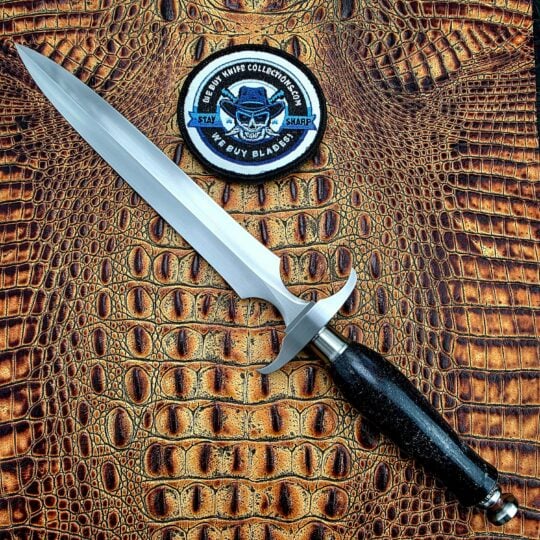
A photographed example from the Casteel workshop is a 13-inch custom art dagger with a 7.9-inch satin-finished blade, sculptural stainless S-guard, and polished dark stone handle. Its script “Di” signature identifies Dianna’s work. These details illustrate the maker’s approach to custom fixed-blade knives without implying that every Casteel knife shares the same specifications.
Natural Stone Handles and Decorative Metalwork
Natural stone became a defining area of experimentation for the Casteel workshop. Doug described the couple’s interest in the colors, textures, and irregularities of polished stone. He specifically named jade and lapis lazuli among their favorite materials. Stone is more demanding to shape and fit than many conventional knife-handle materials, so intact examples deserve careful inspection.
Alongside stone handles, Casteel work can feature pearl, ivory, decorative stainless fittings, and Damascus blades. Documented maker-directory entries describe Dianna’s use of 440C and stainless Damascus. Materials vary by knife; an alloy or mineral should not be assigned to an individual example without reliable supporting evidence. The Knife Knowledge library provides broader terminology for collectors assessing handmade blades.
Award-Winning Work and Knifemakers’ Guild Recognition
Dianna earned recognition in the American custom knife community independently of the shared workshop. She received a Best Miniature award at the 2002 Southeastern Custom Knife Show. In 2009, her work won Best Art Knife at the Knifemakers’ Guild Show. She later received the Red Watson Award at the 2015 International Custom Cutlery Exposition.
These awards, together with her documented maker’s mark and Guild involvement, give collectors a stronger historical foundation for assessing her work. The Knifemakers’ Guild now lists Dianna among its emeritus makers, meaning she is retired from the knife business. Existing knives therefore circulate primarily through private collections and the secondary market.
Identification, Originality, and Collector Value
Collectors should distinguish a knife signed by Dianna from a knife marked by Doug or attributed only to the Casteel Knives workshop. Historical maker directories describe Dianna’s mark as a script “D.” On some surviving examples, it resembles the handwritten letters “Di.” Construction, markings, accompanying paperwork, and comparable documented examples all help establish a reliable attribution.
Condition matters, especially for polished stone handles, finely finished blades, and decorative guards. Original business cards and cases can add context, but a workshop contact card is not the same as a signed certificate of authenticity. WBKC’s provenance standards and condition grading approach explain the importance of accurate representation.
Shop and Sell Dianna Casteel Custom Knives
Availability depends on which individually made pieces enter the collector market. Browse preowned collector knives or explore available knives for current inventory. Listings provide the details known for each example rather than assuming that all knives from the maker share identical materials or construction.
Owners of signed Casteel art daggers, miniatures, and other qualifying customs may submit individual knives or collections for review. Learn about selling a custom knife collection and the types of knives considered for purchase.
Frequently Asked Questions About Dianna Casteel Custom Knives
Who is Dianna Casteel?
Dianna Casteel is a retired American custom knifemaker associated with the Casteel Knives workshop in Monteagle, Tennessee. She began making knives in 1989 and became known for art daggers, miniature knives, boot knives, and fighters.
Did Dianna and Doug Casteel make the same knives?
No. They worked under the shared Casteel Knives name but made individual pieces. Doug was particularly associated with large Bowies, swords, and presentation knives. Dianna specialized in daggers and miniatures, while also making other fixed-blade designs.
What is the maker’s mark on a Dianna Casteel knife?
A historic custom-knifemaker directory identifies her mark as a script “D.” Some examples show a flowing signature that appears to read “Di.” The signature should be assessed alongside the knife’s design and available documentation.
What materials were used in Casteel custom knives?
Materials varied between pieces. Historical sources document 440C, stainless Damascus, polished natural stone, pearl, and decorative metalwork. Jade and lapis lazuli were among the workshop’s preferred stones. An exact blade alloy or handle mineral requires identification specific to the individual knife.
Why are Casteel stone-handled knives collectible?
The workshop’s stone-handled knives combine handmade blade construction with materials that require careful shaping and fitting. Their natural patterns also make individual examples visually distinctive. Originality and the absence of chips or cracks are important considerations.
What awards did Dianna Casteel receive?
Documented honors include Best Miniature at the 2002 Southeastern Custom Knife Show, Best Art Knife at the 2009 Knifemakers’ Guild Show, and the Red Watson Award at the 2015 International Custom Cutlery Exposition.
Are Dianna Casteel knives still being made?
Dianna is listed among the Knifemakers’ Guild’s emeritus makers and is retired from the knife business. Collectors generally encounter her work through existing collections and secondary-market listings.
How do I evaluate an older Casteel art dagger?
Examine the signature, blade geometry, guard fit, handle condition, and any original paperwork. Check for later alterations, polishing, chips, or repaired stone. The guide to choosing a custom knife covers additional considerations.
Does an original Casteel business card prove authenticity?
A period contact card helps document the historic workshop, but it does not independently authenticate a particular knife. A maker’s signature, construction details, and reliable provenance carry greater evidentiary weight. See Why Collectors Trust Us for WBKC’s approach.
Where can I buy or sell Dianna Casteel Custom Knives?
Availability changes as privately held pieces enter the market. Browse knives currently available or visit Sell Your Knife Collection to submit qualifying examples for review.