Half Face Blades
- 3LegDog Knives (1)
- 417CNC Knives (1)
- A2 Knives (1)
- Allen Elishewitz Custom Knives (3)
- André Thorburn Custom Knives (2)
- Andriy Mozil Custom Knives (3)
- Anton van der Westhuizen Custom Knives (1)
- Arno Bernard Knives (2)
- Bill Coffey Custom Knives (1)
- Bill Poor Custom Knives (1)
- Billy Mace Imel Custom Knives (2)
- Blackside Customs (5)
- Borka Blades & Sebastijan Berenji (2)
- Brandon Vallotton Custom Knives (2)
- Brian Milinski Custom Knives (1)
- Brian Tighe Custom Knives (2)
- Brown Knives by Craig Brown (3)
- Buddy Gaines Custom Knives (1)
- Burn Knives by Paul Panak (5)
- Chris Reeve Knives (12)
- Chuck Gedraitis Custom Knives (3)
- Clark Blades by David Clark (1)
- Corrie Schoeman Custom Knives (1)
- Curt Zimmermann Custom Knives (3)
- Curtiss Knives (1)
- Custom Knife Factory (CKF) (7)
- Darac Steel & Dario Zadravec (1)
- Daryl Hibben Custom Knives (1)
- David Broadwell Custom Knives (2)
- DDR Knives - Darrel Ralph (2)
- Dervish Knives - John Gonzalez (2)
- Desert Sage Blades (1)
- Dew Hara Custom Knives (23)
- Dianna Casteel Custom Knives (1)
- Direware Knives (1)
- DSK Tactical (3)
- Eliot "E.F." Maldonado Custom Knives (2)
- Emerson Knives (1)
- FengLi (1)
- Ferrum Forge Knife Works (1)
- Fischer Brothers Custom Knives (1)
- Francois du Toit Custom Knives (1)
- Glenn Are Hovin Custom Knives (2)
- Glenn Waters Custom Knives (2)
- Greg Lightfoot Custom Knives (1)
- Grimsmo Knives (3)
- Hawk Knife Designs (5)
- Haymaker Customs (1)
- Heretic Knives (7)
- Herman Knives (4)
- Herucus Blomerus Custom Knives (1)
- Hog House Knives (4)
- Holley Knife Company (2)
- Holt Bladeworks (1)
- Hoss Knives (2)
- Hypercut Manufacturing - Dylan Davis (3)
- J.B. Stout & Stout Knife & Tool (1)
- Jaco De Kock Custom Knives (4)
- Jason Clark & Clark Custom Knives (2)
- JD Van Deventer Custom Knives (1)
- Jeff Chaffee Custom Knives (1)
- Jeff VanderMeulen Custom Knives (1)
- Jerry Hossom Custom Knives (1)
- Jim Sornberger Custom Knives (1)
- JKK Custom Knives by Jen Lint (1)
- John Gray Custom Knives (4)
- KC Gray Custom Knives (1)
- Keanison Knives (1)
- Keith Kruger Custom Knives (1)
- Kit Carson (1)
- Koenig Knives (3)
- Koji Hara Custom Knives (3)
- Kyle Vallotton Custom Knives (1)
- La Cantina Knives (1)
- Larry Pridgen Custom Knives (1)
- Les George Knives (1)
- Lone Wolf Knives (1)
- Maniac Machining (3)
- Marfione Custom Knives (7)
- Medford Knife & Tool (1)
- Mel Pardue Custom Knives (1)
- Melvin Lozada Custom Knives (4)
- Michael Zieba Custom Knives (1)
- Microtech Knives (6)
- Miroc Blade Works (1)
- Munroe Metalworks Custom Knives (1)
- NADEN Knives by Fellhoelter & Willumsen (1)
- NCC Knives (1)
- Neels van den Berg (Black Dragon Forge) (1)
- Nicholas Nichols Knives (1)
- NOC Knives (1)
- Olamic Cutlery (2)
- Pat Crawford Custom Knives (1)
- Patrick Famin Custom Knives (4)
- Poikilo Blade (1)
- Prince Customs (1)
- ProTech Knives (2)
- Rainy Vallotton Custom Knives (2)
- Randy Doucette Custom Knives (1)
- Ray Laconico Custom Knives (1)
- Reese Weiland Custom Knives (11)
- Rick Barrett Custom Knives (2)
- RMOR Knives (2)
- Robjohnsons Custom Knives (1)
- Rockstead Knives (2)
- Scorpion 6 Knives (5)
- Scott Gallagher Custom Knives (2)
- Sergey Rogovets Custom Knives (1)
- Shane Atwood & Atwood Custom Knives (3)
- Sharknivco Knives (1)
- Shirogorov Knives (2)
- Simeon Custom Knives (1)
- Skiff Made Blades (2)
- Stefano Compostella Custom Knives (2)
- Strider Knives (3)
- Tim Britton Custom Knives (1)
- Tuch Knives (1)
- ViKnives Customs by Victor Barajas (1)
- W. Guinn Custom Knives (1)
- William Henry Knives (1)
- Yan Knives (1)
Showing all 3 resultsSorted by latest

Half Face Blades
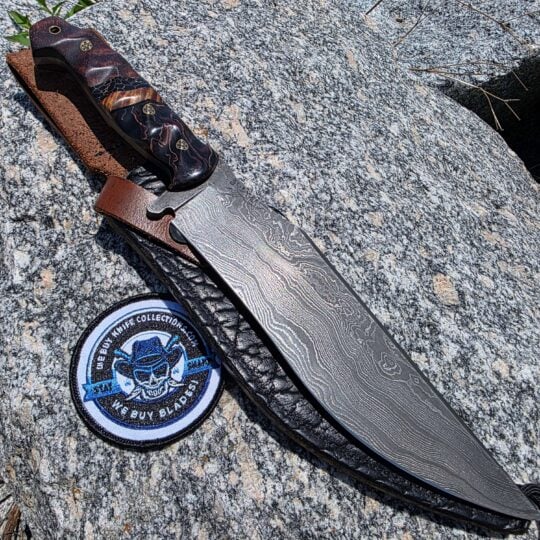
Half Face Blades brings a distinctive look to American knives through angled handle splits, contrasting natural materials, and detailed metal accents. Dark wood can meet pale antler across a fine brass line. Other builds emphasize textured G10, patterned carbon fiber, or the copper layers of an etched blade.
Founded by retired Navy SEAL Andrew Arrabito, the San Diego company makes field knives, custom builds, folders, and axes. Its range gives collectors several ways to explore the brand, from a practical Crow Scout to an elaborate custom OSS Spike. Browse the examples on this page to compare individual configurations, photographs, and condition.
Andrew Arrabito and the Origins of Half Face Blades
Arrabito grew up hunting, camping, and fishing in Northern California. After his military service, he began making knives beneath an awning in his backyard. Early knives went to friends still serving in the SEAL Teams, whose requests encouraged him to keep building.
That beginning established a practical approach to design. Arrabito describes choosing steel, heat treatment, blade thickness, and grinding angles around the intended task. A hunting knife and a larger field tool call for different decisions. As HFB grew into a team operation, its catalog expanded to include both recurring production models and more elaborate custom work.
Crow Scout, Disaster, and Other HFB Fixed Blades
Crow Scout and Crow Jr: The Crow Scout is the larger of these two field knives. The Crow Jr offers a more compact alternative, with a shorter blade and handle. G10 and carbon fiber builds bring different surface textures and patterns to the family.
Disaster series: The Disaster Breacher, Disaster Jr, and Disaster Cub give enthusiasts several sizes and generations to explore. Compare blade profiles, dimensions, and handle construction when choosing between versions, including the Disaster Jr Gen 3.
OSS Spike: Its slender outline offers a sharp visual contrast to the broader field knives. Selected custom examples pair that narrow blade with patterned steel, split handles, and decorative pins.
Hunting and outdoor models: Designs such as the Cavner, Crow Breakdown, and Skinner extend the lineup into other field applications. Explore our fixed blade knife collection to compare available examples with work from other makers.
Folding Knives, Axes, and Tomahawks
The catalog also includes Crow, Disaster, and Kwaiken folders. These bring a different kind of mechanical interest to the brand. For example, HFB has offered the Kwaiken Folder with an integral aluminum handle, a button lock, and a titanium pocket clip.
Axes and tomahawks broaden the range, with different head shapes, handle contours, and decorative treatments to explore. Browse our tomahawk collection to compare individual makers and designs.
Split Handles: Wood, Antler, Carbon Fiber, and Metal
The angled split is a recurring feature of HFB handle work. A single scale can combine two contrasting materials, separated by G10 and thin metallic accents. Figured wood, antler, Micarta, and carbon fiber each produce a different combination of color, grain, and texture.
Small choices change the overall effect. A smooth grip emphasizes the natural figure of the material; a textured grip brings the contouring forward. Mosaic pins introduce small geometric patterns, while brass or copper striping defines the transition between handle sections.
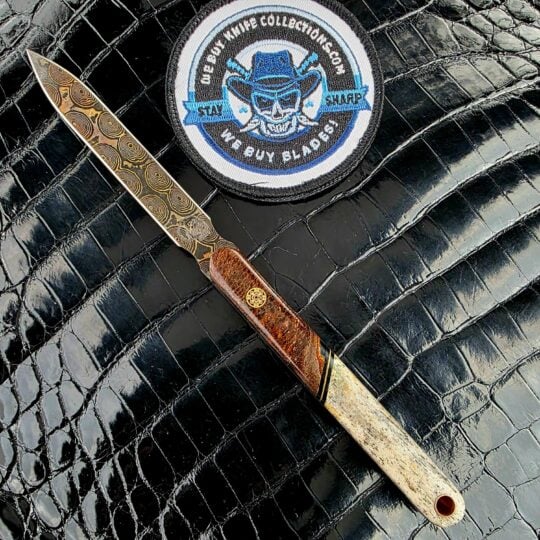
The custom OSS Spike in our brand photograph pairs Giant Irish elk antler with Colorado elk antler. Black G10 and brass separate the contrasting sections, while a mosaic pin and copper lanyard tube finish the handle.
Blade Steels and Baker Forge CopperMai
Half Face Blades uses different steels across its models and custom builds. S45VN appears in Crow Scout and Crow Jr builds, while HFB has used 3V for the Disaster Jr Gen 3. Finishes also vary, with acid etching, nitride, and Cerakote appearing across the catalog.
Baker Forge CopperMai adds another dimension to selected customs. This family of laminated steels incorporates copper, producing contrasting lines and patterns as the blade is ground and etched. The Raindrop pattern on our photographed example forms concentric rings across the blade face.
For a collector, the combination matters: steel construction, blade shape, finish, and handle treatment all contribute to the finished knife. Our guide to choosing a custom knife explores those considerations in more detail.
Production Models, Custom Builds, and Auction Pieces
HFB produces recurring models alongside custom builds and selected auction pieces. Natural materials also appear on production knives, including models with bolt-on scales. Collectors can therefore explore a familiar design through different handle treatments, blade finishes, and release histories.
Scheduled online releases and special auctions have been part of the company’s approach. An original listing or purchase record can connect a knife to its release and identify the materials selected for that build. Our approach to knife provenance explains how we present that history when it is available.
Choosing an HFB Knife for Your Collection
One approach is to follow the Crow or Disaster family across handle materials and generations. Another is to compare HFB’s different shapes, from compact field knives to spikes and axes. A group of split-handle customs can also highlight the workshop’s use of natural materials.
On preowned examples, condition and completeness help distinguish otherwise similar knives. Examine the edge, blade finish, handle surfaces, hardware, and sheath. Our condition grading standards explain how those details are assessed. Each listing identifies the accessories and documentation included with that particular piece.
Shop Half Face Blades at We Buy Knife Collections
Explore each HFB listing for photographs of the actual knife, materials, measurements, condition, and included accessories. Those details help you compare a particular configuration with the pieces already in your collection.
To explore other makers and styles, browse our complete knife inventory. Compare the photographs, materials, and condition to find the example that earns a place in your collection.
Half Face Blades FAQ
Who founded Half Face Blades?
Andrew Arrabito, a retired Navy SEAL, founded the company. His early knives were made for friends still serving in the Teams. HFB later grew into a team operation producing a wider range of knives and tools.
Where are Half Face Blades knives made?
HFB is based in San Diego, California, and states that all its knives are made in the USA. Arrabito has also discussed working with American manufacturing partners on folding knives.
Are all HFB knives custom or one-of-a-kind?
No. The range includes production models and custom builds. Some production knives also feature elaborate natural-material handles. A specific knife’s original maker description is the best basis for identifying its configuration and any stated edition details.
What is the difference between a Crow Scout and a Crow Jr?
The Crow Scout is the larger design. HFB has offered the Scout with a 5-inch blade and the Jr with a 4-inch blade. Handle materials, finishes, and other specifications can vary between individual offerings.
What is an HFB split-scale handle?
A split-scale handle combines distinct sections of material within each handle side. HFB frequently uses angled transitions, G10 separators, and metallic accents. Smooth and textured versions give the materials different visual and tactile qualities.
What is CopperMai?
CopperMai is Baker Forge’s family of copper-laminated steels. Grinding and etching reveal the contrasting layers. Patterns and steel combinations vary, so the specific build determines the blade’s composition and appearance.
Do HFB knives come with a Kydex sheath?
Many HFB fixed blades are paired with Kydex, while some come with leather sheaths. The individual product listing identifies the sheath included with that knife.
How can I document an auction or special-release knife?
Keep the original maker listing, receipt, and any correspondence that identifies the piece. These records can establish the stated materials and release history. They are especially useful when several knives share a similar outline or handle treatment.
Can I sell my HFB knife or collection?
You can submit your knife collection for review. Include clear photographs, known model and material details, condition, and original accessories. We assess submissions individually according to the pieces offered and our current buying criteria.