
Lone Wolf Knives
 Custom Flashlights and Torches
- 3LegDog Knives (1)
- 417CNC Knives (1)
- A2 Knives (1)
- Allen Elishewitz Custom Knives (3)
- André Thorburn Custom Knives (2)
- Andriy Mozil Custom Knives (2)
- Anton van der Westhuizen Custom Knives (1)
- Arno Bernard Knives (2)
- Bill Coffey Custom Knives (1)
- Bill Poor Custom Knives (1)
- Billy Mace Imel Custom Knives (2)
- Blackside Customs (5)
- Borka Blades & Sebastijan Berenji (2)
- Brandon Vallotton Custom Knives (2)
- Brian Milinski Custom Knives (1)
- Brian Tighe Custom Knives (2)
- Brown Knives by Craig Brown (3)
- Buddy Gaines Custom Knives (1)
- Burn Knives by Paul Panak (5)
- Chris Reeve Knives (12)
- Chuck Gedraitis Custom Knives (3)
- Clark Blades by David Clark (1)
- Corrie Schoeman Custom Knives (1)
- Curt Zimmermann Custom Knives (3)
- Curtiss Knives (1)
- Custom Knife Factory (CKF) (7)
- Darac Steel & Dario Zadravec (1)
- Daryl Hibben Custom Knives (1)
- David Broadwell Custom Knives (2)
- DDR Knives - Darrel Ralph (2)
- Dervish Knives - John Gonzalez (2)
- Desert Sage Blades (1)
- Dew Hara Custom Knives (23)
- Dianna Casteel Custom Knives (1)
- Direware Knives (1)
- DSK Tactical (3)
- Eliot "E.F." Maldonado Custom Knives (2)
- Emerson Knives (1)
- FengLi (1)
- Ferrum Forge Knife Works (1)
- Fischer Brothers Custom Knives (1)
- Francois du Toit Custom Knives (1)
- Glenn Are Hovin Custom Knives (2)
- Glenn Waters Custom Knives (2)
- Greg Lightfoot Custom Knives (1)
- Grimsmo Knives (2)
- Half Face Blades (3)
- Hawk Knife Designs (5)
- Haymaker Customs (1)
- Heretic Knives (7)
- Herman Knives (4)
- Herucus Blomerus Custom Knives (1)
- Hog House Knives (4)
- Holley Knife Company (2)
- Holt Bladeworks (1)
- Hoss Knives (2)
- Hypercut Manufacturing - Dylan Davis (3)
- J.B. Stout & Stout Knife & Tool (1)
- Jaco De Kock Custom Knives (4)
- Jason Clark & Clark Custom Knives (2)
- JD Van Deventer Custom Knives (1)
- Jeff Chaffee Custom Knives (1)
- Jeff VanderMeulen Custom Knives (1)
- Jerry Hossom Custom Knives (1)
- Jim Sornberger Custom Knives (1)
- JKK Custom Knives by Jen Lint (1)
- John Gray Custom Knives (4)
- KC Gray Custom Knives (1)
- Keanison Knives (1)
- Keith Kruger Custom Knives (1)
- Kit Carson (1)
- Koenig Knives (3)
- Koji Hara Custom Knives (3)
- Kyle Vallotton Custom Knives (1)
- La Cantina Knives (1)
- Larry Pridgen Custom Knives (1)
- Les George Knives (1)
- Maniac Machining (3)
- Marfione Custom Knives (7)
- Medford Knife & Tool (1)
- Mel Pardue Custom Knives (1)
- Melvin Lozada Custom Knives (4)
- Michael Zieba Custom Knives (1)
- Microtech Knives (6)
- Miroc Blade Works (1)
- Munroe Metalworks Custom Knives (1)
- NADEN Knives by Fellhoelter & Willumsen (1)
- NCC Knives (1)
- Neels van den Berg (Black Dragon Forge) (1)
- Nicholas Nichols Knives (1)
- NOC Knives (1)
- Olamic Cutlery (2)
- Pat Crawford Custom Knives (1)
- Patrick Famin Custom Knives (3)
- Poikilo Blade (1)
- Prince Customs (1)
- ProTech Knives (2)
- Rainy Vallotton Custom Knives (2)
- Randy Doucette Custom Knives (1)
- Ray Laconico Custom Knives (1)
- Reese Weiland Custom Knives (11)
- Rick Barrett Custom Knives (2)
- RMOR Knives (2)
- Robjohnsons Custom Knives (1)
- Rockstead Knives (2)
- Scorpion 6 Knives (5)
- Scott Gallagher Custom Knives (2)
- Sergey Rogovets Custom Knives (1)
- Shane Atwood & Atwood Custom Knives (3)
- Sharknivco Knives (1)
- Shirogorov Knives (2)
- Simeon Custom Knives (1)
- Skiff Made Blades (2)
- Stefano Compostella Custom Knives (2)
- Strider Knives (3)
- Tim Britton Custom Knives (1)
- Tuch Knives (1)
- ViKnives Customs by Victor Barajas (1)
- W. Guinn Custom Knives (1)
- William Henry Knives (1)
- Yan Knives (1)
Showing the single result
Lone Wolf Knives was an Oregon knife company known for finely finished folding knives, distinctive locking mechanisms, and collaborations with respected designers. Founded by former Gerber executive Jim Wehrs in 2001, the company combined precision production with details associated with custom knives. Today, its early Paul-series folders, Harsey designs, and limited editions remain of interest to collectors of discontinued American knife brands.
The History of Lone Wolf Knives
Jim Wehrs established the company after serving as president of Gerber Legendary Blades. Based in Oregon, Lone Wolf initially emphasized semi-custom manufacturing, quality materials, and established knifemaking talent. Its early collaborators included Paul W. Poehlmann, William W. Harsey Jr., and Bob Loveless. The designs ranged from refined gentleman’s folders to working knives for tactical and outdoor use.
The company’s original identity was closely tied to careful machining and unusual mechanisms. For collectors exploring the designers behind these knives, our Knife Knowledge library provides additional background on knife construction and terminology.
Paul W. Poehlmann and the Paul Executive, Presto, and Perfecto
The Paul series is among Lone Wolf’s most recognizable offerings. Designer and engineer Paul W. Poehlmann developed a patented axial locking mechanism that uses the central pivot assembly to release the blade. Unlike a conventional liner lock, the Paul mechanism secures the blade in both its fully open and closed positions. It is also distinct from Benchmade’s later AXIS crossbar lock.
Notable versions include the compact Paul Executive, the curved-blade Paul Presto, and the Wharncliffe-style Paul Perfecto. The 2009 Lone Wolf catalog lists a 2.5-inch drop-point blade for the standard Executive and a 2.4-inch blade for the Presto. However, configurations differ across models and special editions.
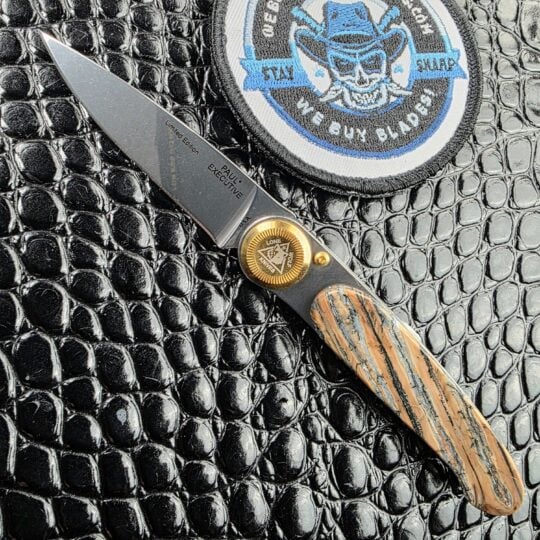
The photographs on this page show a Paul Executive Limited Edition with mammoth-tooth handle scales and a gold-tone pivot medallion carrying the Lone Wolf emblem. Its blade bears the “Limited Edition” and “PAUL EXECUTIVE” markings. These visible details distinguish the pictured knife, although its exact edition size and factory item number have not been established.
William W. Harsey and Lone Wolf’s Tactical Designs
William W. Harsey Jr. brought a different design approach to the lineup. His Harsey T-series folders emphasized robust construction, practical blade geometry, and materials suited to demanding use. The T-2 Ranger, for example, was offered with a CPM-S30V blade and titanium frame components.
The range extended beyond the T-series. Lone Wolf also cataloged the Harsey D2 automatic and other distinctive folders, including the Blackfoot, Longhorn, Lobo, and Double-Duty. Some models used hidden scale-operated automatic mechanisms. Others relied on conventional manual locks. Compare these design approaches with other collectible folding knives in our inventory.
Limited Editions, Mammoth Tooth, and Collectible Materials
Natural handle materials and special treatments form an important part of the brand’s history. Depending on the model, Lone Wolf offered cocobolo, burl wood, Micarta, carbon fiber, G-10, decorative stone, and fossil mammoth tooth. Its 2009 limited-edition catalog documented a mammoth-tooth Paul Presto and special Paul Executive variants, including Red Dawn and David Yellowhorse’s Lawman.
Those examples illustrate the breadth of factory offerings, not a claim that every unusual handle was produced in a numbered edition. On an individual knife, packaging, original paperwork, markings, and documented ownership can help establish its specific configuration. Learn why provenance matters when evaluating older collectible knives.
The Benchmade Acquisition and the End of Production
Benchmade acquired Lone Wolf on October 5, 2010. The brand continued afterward, with greater emphasis on hunting and outdoor knives. Post-acquisition products included the Trask and Swale folders, along with Mountainside-series fixed blades. As of 2016, industry reporting described the Lone Wolf line as discontinued.
As a result, buyers generally encounter these knives through the secondary market rather than a current factory catalog. Condition, originality, operation, and accessories vary from example to example. Our published condition grading standards explain how we assess collectible knives, while our preowned knives category provides additional buying options.
Collecting and Selling Lone Wolf Knives
Collectors often focus on the original Paul mechanism, Harsey collaborations, uncommon handle materials, and well-documented limited editions. A complete example with its factory packaging may appeal to a different buyer than a carried user. However, a “Limited Edition” etching alone does not establish a specific production quantity or investment value.
Browse our Shop All Knives inventory for current selections. If you have collectible examples or an established collection to offer, you can also sell your knife collection through our evaluation process. Availability and purchase interest depend on the individual pieces.
Frequently Asked Questions About Lone Wolf Knives
Who founded Lone Wolf Knives?
Jim Wehrs, a former president of Gerber Legendary Blades, founded the company in Oregon in 2001. Early collaborations helped establish its reputation for precision-built folding knives.
Are Lone Wolf Knives still being manufactured?
The historical brand is discontinued. Benchmade acquired Lone Wolf in 2010 and continued releasing knives under the name afterward. Industry reporting confirmed the brand’s closure by 2016.
What is a Lone Wolf Paul Executive?
It is a compact gentleman’s folding knife based on Paul W. Poehlmann’s patented axial-lock design. The original catalog described a 2.5-inch drop-point blade on the standard Executive. Handle materials and finishes varied among regular and special editions.
Is the Paul axial lock the same as Benchmade’s AXIS lock?
No. The Paul system operates through a spring-loaded component inside the pivot assembly. Benchmade’s AXIS lock instead uses a sliding crossbar. Both designs are documented separately in Benchmade’s 2011 catalog.
Which historic Lone Wolf models are especially interesting to collectors?
Collectors may seek Paul Executive, Presto, and Perfecto folders, as well as Harsey T-series knives. Limited editions, unusual scale materials, and original packaging can add interest. Preferences and market demand vary by model and condition.
Were all Lone Wolf knives made in the United States?
Many original models were cataloged as American-made, including several Paul-series folders and tactical designs. However, manufacturing origin should be checked for each model and production period. A brand name alone does not establish where every knife was manufactured.
What should I examine before purchasing a vintage example?
Look at blade condition, pivot function, lock engagement, handle integrity, and evidence of refinishing. Original boxes, paperwork, and credible model documentation are useful. For limited editions, distinguish a factory marking from a documented production count.
Can I sell a Lone Wolf knife or collection?
Yes, you can submit collectible pieces for review. Include clear photographs, the model name, condition details, and any original accessories. Each submission is assessed individually, and not every knife will qualify for an offer.