
Reese Weiland Custom Knives
- 3LegDog Knives (1)
- 417CNC Knives (1)
- A2 Knives (1)
- Allen Elishewitz Custom Knives (3)
- André Thorburn Custom Knives (2)
- Andriy Mozil Custom Knives (3)
- Anton van der Westhuizen Custom Knives (1)
- Arno Bernard Knives (2)
- Bill Coffey Custom Knives (1)
- Bill Poor Custom Knives (1)
- Billy Mace Imel Custom Knives (2)
- Blackside Customs (5)
- Borka Blades & Sebastijan Berenji (2)
- Brandon Vallotton Custom Knives (2)
- Brian Milinski Custom Knives (1)
- Brian Tighe Custom Knives (2)
- Brown Knives by Craig Brown (3)
- Buddy Gaines Custom Knives (1)
- Burn Knives by Paul Panak (5)
- Chris Reeve Knives (12)
- Chuck Gedraitis Custom Knives (3)
- Clark Blades by David Clark (1)
- Corrie Schoeman Custom Knives (1)
- Curt Zimmermann Custom Knives (3)
- Curtiss Knives (1)
- Custom Knife Factory (CKF) (7)
- Darac Steel & Dario Zadravec (1)
- Daryl Hibben Custom Knives (1)
- David Broadwell Custom Knives (2)
- DDR Knives - Darrel Ralph (2)
- Dervish Knives - John Gonzalez (2)
- Desert Sage Blades (1)
- Dew Hara Custom Knives (23)
- Dianna Casteel Custom Knives (1)
- Direware Knives (1)
- DSK Tactical (3)
- Eliot "E.F." Maldonado Custom Knives (2)
- Emerson Knives (1)
- FengLi (1)
- Ferrum Forge Knife Works (1)
- Fischer Brothers Custom Knives (1)
- Francois du Toit Custom Knives (1)
- Glenn Are Hovin Custom Knives (2)
- Glenn Waters Custom Knives (2)
- Greg Lightfoot Custom Knives (1)
- Grimsmo Knives (3)
- Half Face Blades (3)
- Hawk Knife Designs (5)
- Haymaker Customs (1)
- Heretic Knives (7)
- Herman Knives (4)
- Herucus Blomerus Custom Knives (1)
- Hog House Knives (4)
- Holley Knife Company (2)
- Holt Bladeworks (1)
- Hoss Knives (2)
- Hypercut Manufacturing - Dylan Davis (3)
- J.B. Stout & Stout Knife & Tool (1)
- Jaco De Kock Custom Knives (4)
- Jason Clark & Clark Custom Knives (2)
- JD Van Deventer Custom Knives (1)
- Jeff Chaffee Custom Knives (1)
- Jeff VanderMeulen Custom Knives (1)
- Jerry Hossom Custom Knives (1)
- Jim Sornberger Custom Knives (1)
- JKK Custom Knives by Jen Lint (1)
- John Gray Custom Knives (4)
- KC Gray Custom Knives (1)
- Keanison Knives (1)
- Keith Kruger Custom Knives (1)
- Kit Carson (1)
- Koenig Knives (3)
- Koji Hara Custom Knives (3)
- Kyle Vallotton Custom Knives (1)
- La Cantina Knives (1)
- Larry Pridgen Custom Knives (1)
- Les George Knives (1)
- Lone Wolf Knives (1)
- Maniac Machining (3)
- Marfione Custom Knives (7)
- Medford Knife & Tool (1)
- Mel Pardue Custom Knives (1)
- Melvin Lozada Custom Knives (4)
- Michael Zieba Custom Knives (1)
- Microtech Knives (6)
- Miroc Blade Works (1)
- Munroe Metalworks Custom Knives (1)
- NADEN Knives by Fellhoelter & Willumsen (1)
- NCC Knives (1)
- Neels van den Berg (Black Dragon Forge) (1)
- Nicholas Nichols Knives (1)
- NOC Knives (1)
- Olamic Cutlery (2)
- Pat Crawford Custom Knives (1)
- Patrick Famin Custom Knives (4)
- Poikilo Blade (1)
- Prince Customs (1)
- ProTech Knives (2)
- Rainy Vallotton Custom Knives (2)
- Randy Doucette Custom Knives (1)
- Ray Laconico Custom Knives (1)
- Rick Barrett Custom Knives (2)
- RMOR Knives (2)
- Robjohnsons Custom Knives (1)
- Rockstead Knives (2)
- Scorpion 6 Knives (5)
- Scott Gallagher Custom Knives (2)
- Sergey Rogovets Custom Knives (1)
- Shane Atwood & Atwood Custom Knives (3)
- Sharknivco Knives (1)
- Shirogorov Knives (2)
- Simeon Custom Knives (1)
- Skiff Made Blades (2)
- Stefano Compostella Custom Knives (2)
- Strider Knives (3)
- Tim Britton Custom Knives (1)
- Tuch Knives (1)
- ViKnives Customs by Victor Barajas (1)
- W. Guinn Custom Knives (1)
- William Henry Knives (1)
- Yan Knives (1)
Showing all 11 resultsSorted by latest
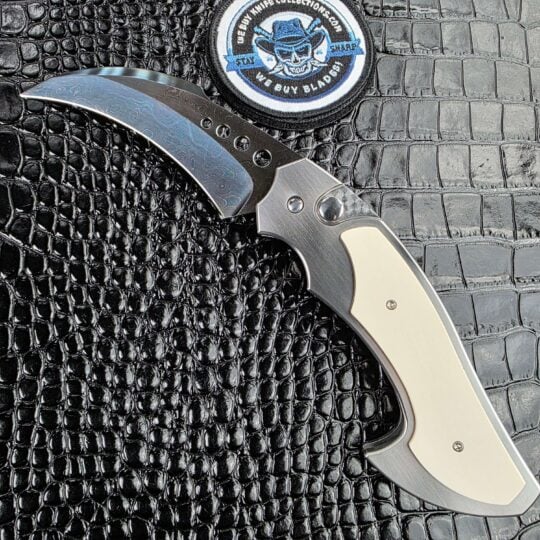
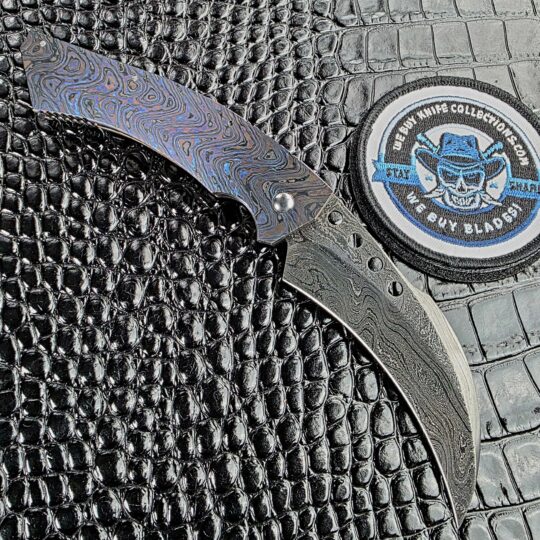


Reese Weiland Knives From the Godfather of the Automatic Knife
Collectors call Reese Weiland the Godfather of the Automatic Knife. Reese Weiland knives span nearly five decades of custom work, from Titanium manual folders to button-fired hawkbills in Damascus and Mammoth. Here, you can buy pieces from across that career, including prototypes he marked himself.
Reese is also a personal friend of We Buy Knife Collections, and an Authorized Dealer of RW Custom Knives. He is one of the best overall knifemakers we have ever known, and we know a lot of knifemakers.
Reese Weiland’s Advice to Aspiring Automatic Knifemakers
We sat down with Reese and asked him a simple question: what would he tell the next generation of automatic knifemakers? He answers from more than 40 years of building automatics. In our view, hearing how a maker thinks about his craft teaches more than any spec sheet.
The Story Behind Reese Weiland Knives
Weiland’s interest in knives began at 12. His uncle, an amateur archaeologist, made knives from old saw blades, and that started everything. Then a book on knifemaking arrived one Christmas, and his first sword came from scrap metal.
He sold his first knife in 1978, according to the 2019 BLADE custom knifemaker directory. He joined the Knifemakers’ Guild in 1988, and he built his first folding knife the following year. Our 1989 Reese Weiland Wasp, a manual hawkbill with Faustina Mead scrimshaw on Buffalo Horn, comes from that first year of folders.
Today he works in Riverview, Florida, and folders make up more than 90 percent of his output. That same directory also lists hawkbills as his specialty, along with locking-liner and button-lock construction.
The Godfather of the Automatic Knife
Weiland has built automatics for more than 40 years. Along the way, designer Joel Pirela commissioned him to build the first prototypes of what became the Microtech Kestrel. Historical accounts also connect him with early work on the Ron Miller Black Knife, where his role was refining the lockup rather than designing the knife.
The nickname honors that long record. It is a community honorific, not a claim that he invented the automatic knife. For the wider field he belongs to, read our guide to master custom knifemakers.
Hawkbills: The Signature of Reese Weiland Knives
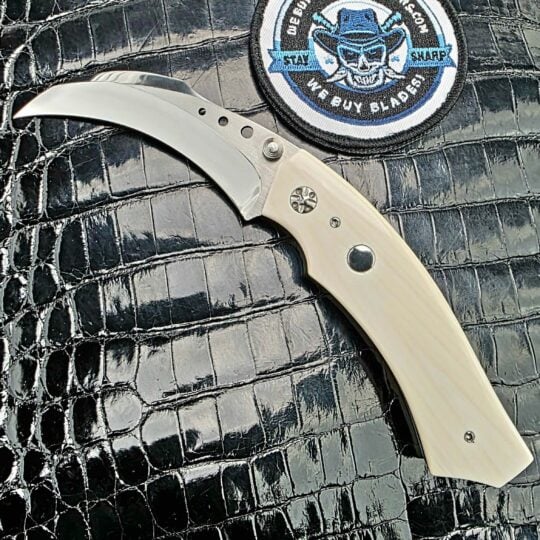
The hawkbill is Weiland’s signature blade. Its edge curves inward like a talon, so it draws material into the cut and works on the pull stroke. Reese Weiland knives carry that curve through the Leopard, Wasp, Hawk, Rastor, Harpy and Hornet, each with its own frame, mechanism and materials.
The Hawkbill 2nd Gen shows how far one model can range. One example pairs a full Timascus frame with Weiland’s own Damascus blade. Another sets Dichrolam inlays in a Titanium frame over a Nitro-V button automatic.
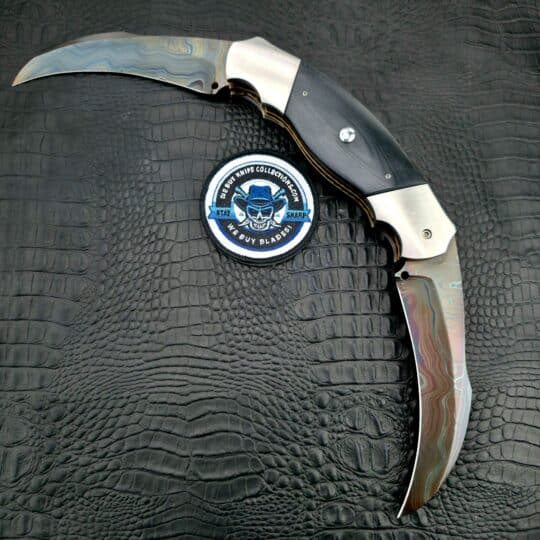
The Hawk is his full-size hawkbill automatic, and our Reese Weiland Hawk Gen II carries a custom Damascus hawkbill. Meanwhile, the Large Rastor pairs a Brad Vice blued Damascus hawkbill with white Mammoth tusk scales on a Stainless Steel frame. A button in its bolster fires the blade.
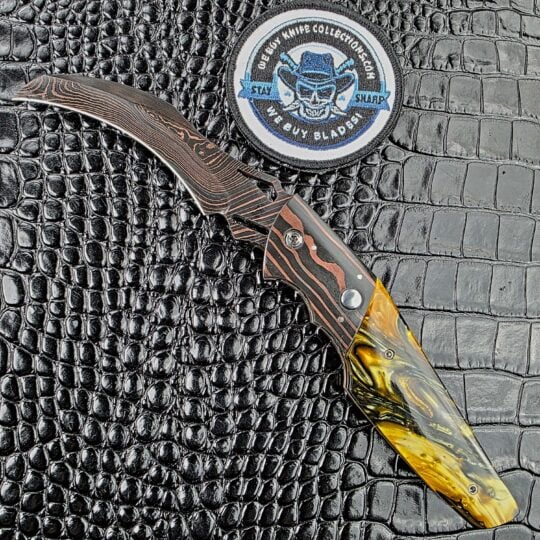
Reese built the Harpy SA Prototype for us, with a Brad Vice Copper Damascus hawkbill and bolsters against Honey Hive Acrylic. The Reese Weiland Hornet, by contrast, carries a smaller hawkbill than his full-size Hawk models. That compact size is exactly what collectors seek out.
Prototypes and the RW PROTO Mark
Weiland marks some of his prototypes RW PROTO. On the Hornet, the mark is engraved inside the spine at the butt. He used the same mark inside the handle of the Tex Bat Prototype, which carries two Brad Vice blued Damascus hawkbills and a single button.
A prototype is a maker’s working build of a design, so it can differ from anything that follows. Still, an RW PROTO mark does not by itself prove a knife is the first or only one of its kind. Documentation and the maker’s own word settle that.
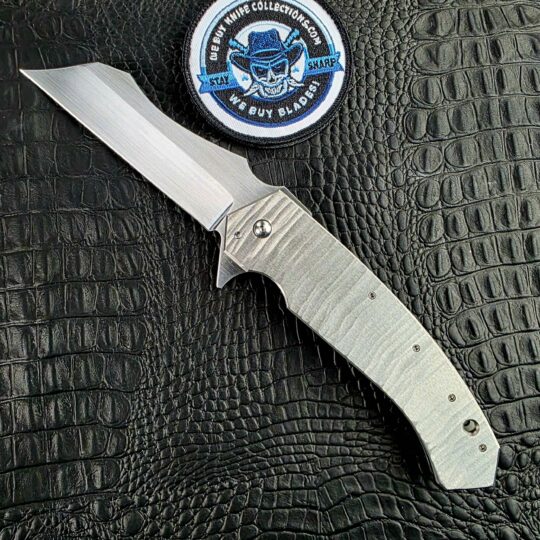
Not every prototype is an automatic, either. The Strike Prototype 2, from 2014, is a manual flipper with a hand-ground Titanium frame lock and a CPM 154 Wharncliffe blade.
Double-Action, Single-Action and Manual Reese Weiland Knives
Weiland builds manual folders, single-action automatics and double-action knives. On his side-opening double-action knives, a thumb stud opens the blade by hand, or a button fires it. Either way, a lock then holds the blade open, and you close it by hand.
That differs from a double-action out-the-front knife, where one control both fires and retracts the blade. So check the mechanism of each exact knife. To compare actions side by side, browse our automatic knives.
Damascus, Timascus, Mammoth and Titanium
Weiland’s materials run from working Titanium to presentation-grade Damascus. Brad Vice blued and Copper Damascus appear on several pieces, while the Timascus Hawkbill 2nd Gen carries Weiland’s own Damascus. Mammoth shows up too: white tusk on the Large Rastor, and molar on the Hornet.
The finishing details matter just as much. Jeweled blue Titanium liners, fileworked backspacers and mosaic pin pivots set individual pieces apart. Because materials vary from knife to knife, read each listing rather than judging by the model name.
Reese Weiland Knives Commissioned Directly From Reese
We have commissioned Reese Weiland knives directly from Reese, including custom Hawkbill 2nd Gen builds. As a result, part of this collection comes straight from his bench in Riverview. See our Direct from Maker knives for other pieces sourced the same way.
What to Look For in a Reese Weiland Automatic
Value rests on the individual knife: its authenticity, originality, action and condition. On an automatic, collectors check that it fires consistently and locks up firmly. They also look at grind symmetry, handle fit, pivot wear, the blade finish and any sign of modification.
Paperwork matters too, especially on prototypes. A maker’s certificate, his correspondence, dated photographs and the original accessories all help. Read how we grade every knife and how we document provenance.
Sell Your Reese Weiland Knives
We buy qualifying Reese Weiland knives, prototypes and full collections, outright or on consignment. Original paperwork, model markings, clear photographs and an honest condition account all help us assess each piece. To begin, sell your knife collection through our submission process.
Reese Weiland Knives FAQ
Why is Reese Weiland called the Godfather of the Automatic Knife?
Collectors use the nickname to honor his decades of work on custom automatics, including early tactical mechanisms. It is a community honorific, so it does not mean he invented the automatic knife.
When did Reese Weiland start making knives?
His interest began at 12, thanks to an uncle who made knives from saw blades. The 2019 BLADE custom knifemaker directory records his first knife sale in 1978. After that, he joined the Knifemakers’ Guild in 1988.
What does double-action mean on a Weiland side-opener?
It means the blade opens two ways: by hand with the thumb stud, or automatically from the button. A lock then holds it, and you close it by hand. A double-action OTF works differently, because one control both fires and retracts its blade.
What is a hawkbill knife used for?
A hawkbill’s edge curves inward, so it pulls material into the cut instead of pushing it away. That makes it effective for pull cuts, such as cutting rope or cord. On Weiland’s knives, the curve is also his signature look.
Are all Reese Weiland knives automatic?
No. Folders make up most of his work, and many of them are manual. For example, the 1989 Wasp is a manual hawkbill, and the Strike Prototype 2 is a manual flipper.
Does an RW PROTO mark mean a knife is one of a kind?
Not necessarily. The mark identifies a prototype, but it does not prove how many were made or that the design came first. A maker’s certificate or other provenance can clarify a particular knife.
What materials does Reese Weiland use?
Documented examples include stainless steels such as Nitro-V and CPM 154, patterned Damascus, Titanium, Timascus, Dichrolam and fossil Mammoth. Some also carry fileworked backspacers and decorative pivots.
Does We Buy Knife Collections buy Reese Weiland knives?
Yes. We buy qualifying Weiland automatics, prototypes and whole collections, and we also take them on consignment. See what we buy in automatics for the kinds of pieces we look for.
Shop Reese Weiland Knives
We inspect, photograph and honestly describe all the Reese Weiland knives we list. Browse the pieces above, or explore other makers through Shop by Maker. For more handmade work, see all of our custom knives.