
Andriy Mozil Custom Knives
 Custom Flashlights and Torches
- 3LegDog Knives (1)
- 417CNC Knives (1)
- A2 Knives (1)
- Allen Elishewitz Custom Knives (3)
- André Thorburn Custom Knives (2)
- Anton van der Westhuizen Custom Knives (1)
- Arno Bernard Knives (2)
- Bill Coffey Custom Knives (1)
- Bill Poor Custom Knives (1)
- Billy Mace Imel Custom Knives (2)
- Blackside Customs (5)
- Borka Blades & Sebastijan Berenji (2)
- Brandon Vallotton Custom Knives (2)
- Brian Milinski Custom Knives (1)
- Brian Tighe Custom Knives (2)
- Brown Knives by Craig Brown (3)
- Buddy Gaines Custom Knives (1)
- Burn Knives by Paul Panak (5)
- Chris Reeve Knives (12)
- Chuck Gedraitis Custom Knives (3)
- Clark Blades by David Clark (1)
- Corrie Schoeman Custom Knives (1)
- Curt Zimmermann Custom Knives (3)
- Curtiss Knives (1)
- Custom Knife Factory (CKF) (7)
- Darac Steel & Dario Zadravec (1)
- Daryl Hibben Custom Knives (1)
- David Broadwell Custom Knives (2)
- DDR Knives - Darrel Ralph (2)
- Dervish Knives - John Gonzalez (2)
- Desert Sage Blades (1)
- Dew Hara Custom Knives (23)
- Dianna Casteel Custom Knives (1)
- Direware Knives (1)
- DSK Tactical (3)
- Eliot "E.F." Maldonado Custom Knives (2)
- Emerson Knives (1)
- FengLi (1)
- Ferrum Forge Knife Works (1)
- Fischer Brothers Custom Knives (1)
- Francois du Toit Custom Knives (1)
- Glenn Are Hovin Custom Knives (2)
- Glenn Waters Custom Knives (2)
- Greg Lightfoot Custom Knives (1)
- Grimsmo Knives (2)
- Half Face Blades (3)
- Hawk Knife Designs (5)
- Haymaker Customs (1)
- Heretic Knives (7)
- Herman Knives (4)
- Herucus Blomerus Custom Knives (1)
- Hog House Knives (4)
- Holley Knife Company (2)
- Holt Bladeworks (1)
- Hoss Knives (2)
- Hypercut Manufacturing - Dylan Davis (3)
- J.B. Stout & Stout Knife & Tool (1)
- Jaco De Kock Custom Knives (4)
- Jason Clark & Clark Custom Knives (2)
- JD Van Deventer Custom Knives (1)
- Jeff Chaffee Custom Knives (1)
- Jeff VanderMeulen Custom Knives (1)
- Jerry Hossom Custom Knives (1)
- Jim Sornberger Custom Knives (1)
- JKK Custom Knives by Jen Lint (1)
- John Gray Custom Knives (4)
- KC Gray Custom Knives (1)
- Keanison Knives (1)
- Keith Kruger Custom Knives (1)
- Kit Carson (1)
- Koenig Knives (3)
- Koji Hara Custom Knives (3)
- Kyle Vallotton Custom Knives (1)
- La Cantina Knives (1)
- Larry Pridgen Custom Knives (1)
- Les George Knives (1)
- Lone Wolf Knives (1)
- Maniac Machining (3)
- Marfione Custom Knives (7)
- Medford Knife & Tool (1)
- Mel Pardue Custom Knives (1)
- Melvin Lozada Custom Knives (4)
- Michael Zieba Custom Knives (1)
- Microtech Knives (6)
- Miroc Blade Works (1)
- Munroe Metalworks Custom Knives (1)
- NADEN Knives by Fellhoelter & Willumsen (1)
- NCC Knives (1)
- Neels van den Berg (Black Dragon Forge) (1)
- Nicholas Nichols Knives (1)
- NOC Knives (1)
- Olamic Cutlery (2)
- Pat Crawford Custom Knives (1)
- Patrick Famin Custom Knives (3)
- Poikilo Blade (1)
- Prince Customs (1)
- ProTech Knives (2)
- Rainy Vallotton Custom Knives (2)
- Randy Doucette Custom Knives (1)
- Ray Laconico Custom Knives (1)
- Reese Weiland Custom Knives (11)
- Rick Barrett Custom Knives (2)
- RMOR Knives (2)
- Robjohnsons Custom Knives (1)
- Rockstead Knives (2)
- Scorpion 6 Knives (5)
- Scott Gallagher Custom Knives (2)
- Sergey Rogovets Custom Knives (1)
- Shane Atwood & Atwood Custom Knives (3)
- Sharknivco Knives (1)
- Shirogorov Knives (2)
- Simeon Custom Knives (1)
- Skiff Made Blades (2)
- Stefano Compostella Custom Knives (2)
- Strider Knives (3)
- Tim Britton Custom Knives (1)
- Tuch Knives (1)
- ViKnives Customs by Victor Barajas (1)
- W. Guinn Custom Knives (1)
- William Henry Knives (1)
- Yan Knives (1)
Showing all 2 resultsSorted by latest
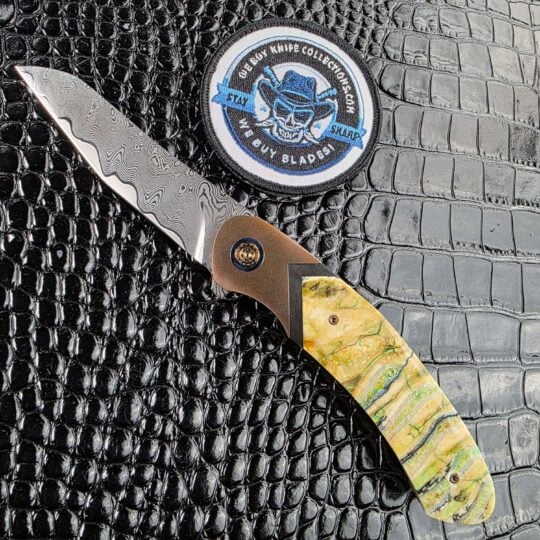
Andriy Mozil Custom Knives: Handmade Collector Folders from Lviv, Ukraine
Andriy Mozil Custom Knives brings together traditional custom-knifemaking presentation and modern premium materials from Lviv, Ukraine. Mozil’s folding knives are built as individually documented pieces, with materials, dimensions, completion dates, and configurations recorded by the maker.
That documentation is especially meaningful to collectors. A knife is more compelling years later when its original configuration can still be traced to the person who built it. On documented examples, Mozil pairs that provenance with modern steels, patterned metals, natural-looking handle materials, and detailed hardware that gives each build its own identity.
Collectors exploring other independent makers can also visit WBKC’s Master Custom Knifemakers and How to Choose a Custom Knife.
A Lviv-Made Custom Knife With Its Origins Preserved
The maker documentation supplied with Mozil’s work identifies Lviv, Ukraine as its place of origin. That connection is reinforced by the presentation packaging, including wooden boxes marked “Ukraine Lviv” and individually completed specification cards.
For a collector, those details turn the knife into more than an attractive combination of materials.
The maker, place of origin, date, dimensions, lock type, blade construction, and handle materials can remain with the knife instead of becoming assumptions passed from one owner to the next.
That is the type of provenance WBKC looks for when evaluating serious collectible knives. Learn more about how we document Provenance and How We Grade.
What Sets Andriy Mozil Custom Knives Apart
The strongest feature of Mozil’s work is the contrast between familiar custom-knife materials and more contemporary decorative metals.
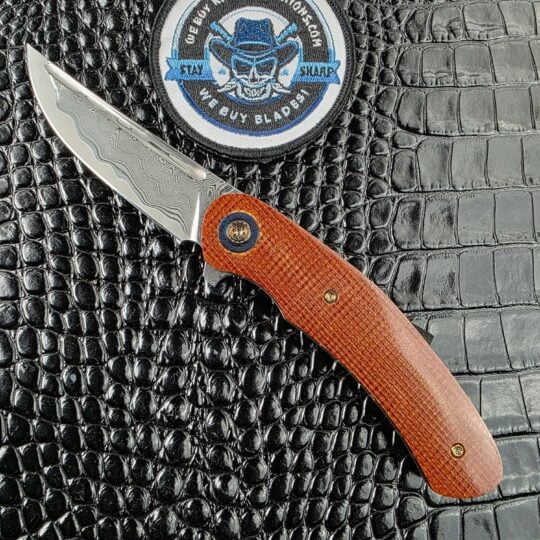
A build may combine warm Micarta with patterned Damascus, then introduce vivid Timascus around the pivot or pocket clip. Those materials are visually very different, but the restrained handle shape keeps them from competing with one another.
The result is a knife that rewards a closer look.
From a distance, the overall silhouette remains clean. Up close, the collector begins to see the Damascus layering, the woven Micarta texture, the color transitions in the Timascus, the pivot construction, and the hand-documented build details.
For collectors, Andriy Mozil Custom Knives can be especially interesting because the individual configuration matters as much as the model number.
Elmax-Core Stainless Damascus
Model 23-26 provides a strong example of Mozil’s approach to blade construction.
Its blade uses an Elmax cutting core clad in stainless Damascus. The exposed layers create the flowing pattern visible across the blade while the Elmax core provides the actual cutting edge.
Elmax is a powder-metallurgy stainless steel valued in knife applications for wear resistance, corrosion resistance, dimensional stability, and edge-holding capability.
On Model 23-26, the fuller visually follows the boundary created by the blade’s layered construction. That detail makes the material transition part of the design rather than hiding it.
Readers interested in learning more about blade steels, construction, and materials can browse WBKC’s Knife Knowledge resources.
Micarta Adds Warmth and Texture
Micarta gives the handle a completely different visual character from the blade.
The brown scales show a pronounced woven texture, adding warmth to an otherwise metal-intensive build. It is a familiar material in working knives because of its durability and tactile surface, but here it also serves an aesthetic purpose.
Against the cool gray Damascus blade and brightly colored Timascus, the Micarta keeps the knife from becoming visually excessive.
That balance is important in a collector piece.
Timascus as a Collector Accent
Timascus introduces the strongest color in the build.
On Model 23-26, the material appears around the pivot and on the sculpted pocket clip, producing visible blue, purple, bronze, and gold tones. Because Timascus is used selectively rather than across the entire handle, it functions as an accent.
The pivot is particularly effective visually. The colorful patterned ring frames the more traditional central pivot hardware and becomes a focal point between the Damascus blade and Micarta handle.
The matching pocket clip continues the same material theme onto the opposite side of the knife.
Liner-Lock Construction
Mozil uses a liner-lock architecture on Model 23-26.
The mechanism keeps the outside of the handle visually clean while allowing the Micarta scales to define most of the knife’s profile. The lock is integrated into the internal frame rather than relying on a large exposed frame-lock bar.
That makes the design feel more like a traditional custom folder even though the materials themselves are distinctly contemporary.
Collectors comparing different construction styles can explore additional premium Folding Knives currently handled by WBKC.
Model Numbers and Build Cards Matter
One of the strongest collector features associated with Mozil’s work is the individual build documentation.
Model numbers allow a particular knife to be identified beyond a general design family. The accompanying handwritten card can preserve details that would otherwise be difficult to reconstruct years later.
On Model 23-26, the card records:
- Model 23-26
- Liner-lock construction
- Elmax in stainless Damascus
- Timascus insert
- Micarta handle
- 95 × 26 × 3.5 mm blade dimensions
- 135 mm handle length
- September 15, 2026 completion date
- Maker signature
The card is handwritten in red ink and remains with the original presentation package.
For a collector, that is considerably more useful than relying on photographs or seller memory years after the knife leaves the maker.
Original Presentation Packaging
The wooden presentation box supplied with Model 23-26 is marked “Ukraine Lviv” and carries the maker’s signature-style branding.
Packaging like this becomes part of the knife’s provenance.
WBKC generally places greater collector emphasis on a complete knife accompanied by original maker documentation and accessories than on an otherwise identical loose knife with no supporting history.
That philosophy is explained further in Why Collectors Trust Us.
Model 23-26: A WBKC Collector Example
WBKC received Model 23-26 directly from Andriy Mozil.
The knife was completed on September 15, 2026 in Lviv and shipped from Ukraine with its original wooden presentation box and handwritten specification card.
Its blade measures 95 mm long, 26 mm high, and 3.5 mm thick. The handle measures 135 mm.
The visual combination is what makes the knife memorable: an Elmax-core stainless Damascus blade, brown Micarta scales, Timascus pivot accents, and a matching Timascus pocket clip.
The build is new from the maker, allowing its provenance to begin with the original documentation intact rather than being reconstructed later.
Why Documentation Matters to Custom-Knife Collectors
Premium custom knives frequently change hands over time.
Once the original buyer is gone, undocumented details can become difficult to verify. Blade steel gets misidentified. Handle materials get described incorrectly. A production year becomes a guess. Aftermarket modifications can eventually be mistaken for maker-original work.
Original documentation helps prevent that.
A signed card, dated build information, original box, and known acquisition path give the next collector a clearer picture of what the knife actually is.
That is particularly valuable with small independent makers whose work may not exist in a large searchable factory database.
A Collector-First Perspective
Small-workshop custom knives are often most interesting when examined as individual objects rather than simply as brand names.
The questions become more specific:
Who made it? When? Where? What materials were used? Is the configuration documented? Is the original packaging present? Has anything been altered?
Those details are central to the way WBKC evaluates Andriy Mozil Custom Knives and other modern custom pieces.
Collectors looking for unusual documented examples can also browse our New Arrivals.
Shop Andriy Mozil Custom Knives at We Buy Knife Collections
WBKC offers Andriy Mozil Custom Knives when qualifying examples become available, with an emphasis on original condition, complete accessories, maker documentation, and unusual material combinations.
Availability may be limited because individually built custom knives do not enter inventory with the predictability of larger production brands.
Browse Shop by Maker or Shop All Knives for current inventory.
If you own an Andriy Mozil knife or another premium custom piece you are considering selling, submit it through Sell Your Collection.
Andriy Mozil Custom Knives FAQ
What is Andriy Mozil Custom Knives?
Andriy Mozil Custom Knives is the work of Ukrainian custom knifemaker Andriy Mozil of Lviv. Documented examples include custom folding knives using premium steels, patterned metals, Micarta, Timascus, and individually completed maker documentation.
Where are Andriy Mozil knives made?
Maker-supplied packaging and documentation identify the knives as originating in Lviv, Ukraine.
What materials does Andriy Mozil use?
Documented Model 23-26 uses an Elmax core clad in stainless Damascus, Micarta handle scales, Timascus accents, and liner-lock construction. Materials may differ from one custom build to another.
What is Model 23-26?
Model 23-26 is a documented custom liner-lock folder completed September 15, 2026. It uses an Elmax-core stainless Damascus blade, Micarta handle scales, Timascus pivot accents, and a matching Timascus pocket clip.
What are the dimensions of Model 23-26?
The maker card records a blade measuring 95 mm long, 26 mm high, and 3.5 mm thick, with a 135 mm handle.
What is Elmax steel?
Elmax is a powder-metallurgy stainless steel used in premium knives. Its property profile emphasizes high wear resistance, corrosion resistance, and good dimensional stability.
What is Timascus?
Timascus is a patterned titanium-based decorative material valued by custom-knife collectors for its layered appearance and vivid colors after finishing and anodizing.
Why is the handwritten maker card important?
The maker card documents the exact model, construction, materials, dimensions, completion date, and signature associated with the knife. That information strengthens provenance and reduces uncertainty on the secondary market.
Does Model 23-26 include its original box?
Yes. The WBKC example includes its fitted wooden presentation box marked “Ukraine Lviv,” along with the original handwritten and signed specification card.
Was WBKC’s Model 23-26 purchased directly from the maker?
Yes. The knife came directly from Andriy Mozil to WBKC, preserving a clear acquisition path from maker to dealer.
Are Andriy Mozil Custom Knives production knives?
No. The examples documented by WBKC are individually built custom knives rather than standardized mass-production models.
Where can I buy Andriy Mozil Custom Knives?
We Buy Knife Collections periodically offers documented Mozil pieces when available. Because these are individually built knives, inventory can be limited.
How can I sell an Andriy Mozil knife?
Include clear photographs of the knife, blade, handle, lock, clip, maker markings, specification card, box, and all original accessories when submitting the knife to WBKC. Complete documentation helps establish configuration and provenance.