
Billy Mace Imel Custom Knives
 Custom Flashlights and Torches
- 3LegDog Knives (1)
- 417CNC Knives (1)
- A2 Knives (1)
- Allen Elishewitz Custom Knives (3)
- André Thorburn Custom Knives (2)
- Andriy Mozil Custom Knives (2)
- Anton van der Westhuizen Custom Knives (1)
- Arno Bernard Knives (2)
- Bill Coffey Custom Knives (1)
- Bill Poor Custom Knives (1)
- Blackside Customs (5)
- Borka Blades & Sebastijan Berenji (2)
- Brandon Vallotton Custom Knives (2)
- Brian Milinski Custom Knives (1)
- Brian Tighe Custom Knives (1)
- Brown Knives by Craig Brown (3)
- Buddy Gaines Custom Knives (1)
- Burn Knives by Paul Panak (5)
- Chris Reeve Knives (12)
- Chuck Gedraitis Custom Knives (3)
- Clark Blades by David Clark (1)
- Corrie Schoeman Custom Knives (1)
- Curt Zimmermann Custom Knives (3)
- Curtiss Knives (1)
- Custom Knife Factory (CKF) (7)
- Darac Steel & Dario Zadravec (1)
- Daryl Hibben Custom Knives (1)
- David Broadwell Custom Knives (2)
- DDR Knives - Darrel Ralph (2)
- Dervish Knives - John Gonzalez (2)
- Desert Sage Blades (1)
- Dew Hara Custom Knives (23)
- Dianna Casteel Custom Knives (1)
- Direware Knives (1)
- DSK Tactical (3)
- Eliot "E.F." Maldonado Custom Knives (2)
- Emerson Knives (1)
- FengLi (1)
- Ferrum Forge Knife Works (1)
- Fischer Brothers Custom Knives (1)
- Francois du Toit Custom Knives (1)
- Glenn Are Hovin Custom Knives (2)
- Glenn Waters Custom Knives (2)
- Greg Lightfoot Custom Knives (1)
- Grimsmo Knives (1)
- Half Face Blades (2)
- Hawk Knife Designs (5)
- Haymaker Customs (1)
- Heretic Knives (7)
- Herman Knives (4)
- Herucus Blomerus Custom Knives (1)
- Hog House Knives (4)
- Holley Knife Company (2)
- Holt Bladeworks (1)
- Hoss Knives (1)
- Hypercut Manufacturing - Dylan Davis (3)
- J.B. Stout & Stout Knife & Tool (1)
- Jaco De Kock Custom Knives (4)
- Jason Clark & Clark Custom Knives (2)
- JD Van Deventer Custom Knives (1)
- Jeff Chaffee Custom Knives (1)
- Jeff VanderMeulen Custom Knives (1)
- Jerry Hossom Custom Knives (1)
- Jim Sornberger Custom Knives (1)
- JKK Custom Knives by Jen Lint (1)
- John Gray Custom Knives (4)
- KC Gray Custom Knives (1)
- Keanison Knives (1)
- Keith Kruger Custom Knives (1)
- Kit Carson (1)
- Koenig Knives (3)
- Koji Hara Custom Knives (3)
- Kyle Vallotton Custom Knives (1)
- La Cantina Knives (1)
- Larry Pridgen Custom Knives (1)
- Les George Knives (1)
- Maniac Machining (3)
- Marfione Custom Knives (7)
- Medford Knife & Tool (1)
- Mel Pardue Custom Knives (1)
- Melvin Lozada Custom Knives (4)
- Microtech Knives (5)
- Miroc Blade Works (1)
- Munroe Metalworks Custom Knives (1)
- NADEN Knives by Fellhoelter & Willumsen (1)
- NCC Knives (1)
- Neels van den Berg (Black Dragon Forge) (1)
- Nicholas Nichols Knives (1)
- NOC Knives (1)
- Olamic Cutlery (2)
- Pat Crawford Custom Knives (1)
- Patrick Famin Custom Knives (3)
- Poikilo Blade (1)
- Prince Customs (1)
- ProTech Knives (2)
- Rainy Vallotton Custom Knives (2)
- Ray Laconico Custom Knives (1)
- Reese Weiland Custom Knives (11)
- Rick Barrett Custom Knives (2)
- RMOR Knives (2)
- Robjohnsons Custom Knives (1)
- Rockstead Knives (2)
- Scorpion 6 Knives (5)
- Scott Gallagher Custom Knives (2)
- Sergey Rogovets Custom Knives (1)
- Shane Atwood & Atwood Custom Knives (3)
- Sharknivco Knives (1)
- Shirogorov Knives (2)
- Simeon Custom Knives (1)
- Skiff Made Blades (2)
- Stefano Compostella Custom Knives (2)
- Strider Knives (3)
- Tim Britton Custom Knives (1)
- Tuch Knives (1)
- ViKnives Customs by Victor Barajas (1)
- W. Guinn Custom Knives (1)
- William Henry Knives (1)
- Yan Knives (1)
Showing all 2 resultsSorted by latest
Billy Mace Imel Custom Knives: Precision, Restraint, and American Craftsmanship
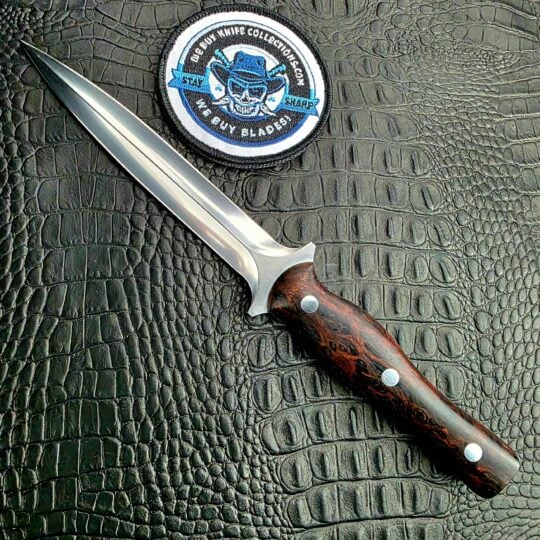
Billy Mace Imel Custom Knives occupy a distinctive place in American handmade cutlery. Known especially for slender integral daggers, Imel pairs exacting geometry with highly polished steel and carefully fitted handle materials. His work reflects decades of traditional machining experience rather than an assembly-line approach. For collectors who study fit, finish, symmetry, and the handwork behind a knife, his pieces reward a closer look.
Based in New Castle, Indiana, Imel helped establish a standard for precisely executed, one-piece knife construction. His career also connects modern enthusiasts to an earlier generation of master custom knife makers who built their reputations at the workbench and through the Knifemakers’ Guild.
From Tool-and-Die Maker to Respected Custom Knifemaker
Before becoming widely recognized for his knives, Billy Mace Imel spent decades working as a tool-and-die maker. His interest in building a better hunting knife took a decisive turn in 1972, after a hunting trip prompted him to examine the work of integral-knife pioneer T. M. Dowell. Rather than purchase a custom hunter, Imel applied his own machining skills and began making knives himself.
He joined the Knifemakers’ Guild in 1973. Over time, his work expanded from hunting knives to daggers, sub-hilt fighters, and folding knives. In a published interview, Imel described his approach as predominantly sole-authorship work, with heat treating and engraving among the exceptions. He preferred conventional machinery and hand-guided grinding over CNC manufacturing. That hands-on tradition remains central to the identity of Billy Mace Imel Custom Knives.
What Makes an Integral Knife Different?
An integral fixed blade begins as a single piece of steel. Instead of attaching a separately made guard and handle frame to a blade, the maker shapes those structural elements from the same bar. This creates a continuous form with no conventional guard joint or separate tang-to-bolster assembly. It also demands careful planning: removing too much material or disturbing the symmetry can compromise the entire piece.
Imel’s integrals are notable for graceful transitions between blade, guard, and handle. The precision is most apparent where the grinds meet the ricasso and where the sculpted guard flows into the grip. Collectors exploring custom fixed-blade knives can use these details to appreciate the difference between an integral construction and a conventionally assembled knife.
Signature Integral Daggers, Hollow Grinds, and Mirror Finishes
For many collectors, the defining expression of Billy Mace Imel Custom Knives is the integral dagger. His double-edged designs favor long, clean lines, sharply defined plunge transitions, and deep hollow grinds that are difficult to execute consistently on both sides of a narrow blade. Their appeal lies as much in technical discipline as in visual drama.
Imel has also built hunters, fighters, and folding knives, so his work should not be reduced to a single pattern. Published accounts identify 440C and D2 among the steels he favored for integral and hunting models, with CPM 154 appearing in folders. Construction, blade steel, and finishing should always be established for the individual knife rather than assumed from the maker’s name.
Interframe Handles, Mammoth Materials, and Finishing Detail
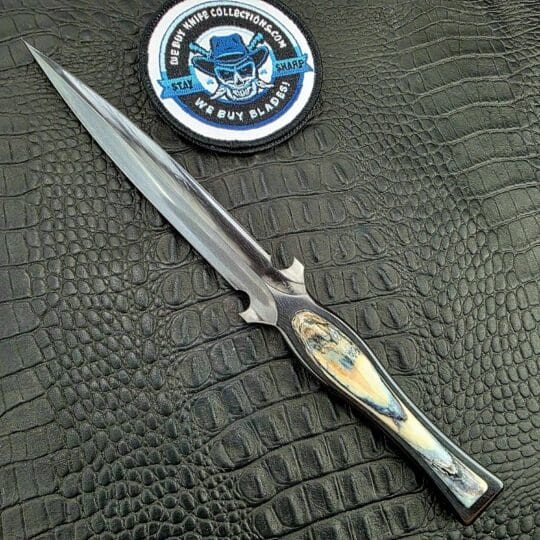
An interframe construction gives the maker a solid frame with precisely machined pockets to receive decorative inlays. On an integral interframe dagger, the steel structure can remain continuous while the handle displays distinctive natural materials. Matching the inlay contours to the surrounding metal requires close fitting, especially when working with ancient mammoth material or other naturally varied scales.
Blackened, bright-mirror, and satin finishes can all change how a knife’s geometry appears under light. In evaluating Billy Mace Imel Custom Knives, collectors should inspect the transitions at the inlay edges, the consistency of the blade grinds, and whether a dark finish is original to the piece. Color alone does not establish which surface-treatment process was used. Our guide to choosing a custom knife offers further perspective on craftsmanship and condition.
A Collector Example: 440C Integral Dagger with Mammoth-Tooth Inlays
One example acquired by We Buy Knife Collections from an estate is a 440C integral interframe dagger with deep double-edge hollow grinds and elongated mammoth-tooth inlays. The entire steel form, including its shaped guard and handle frame, carries a dark, highly reflective black-mirror appearance. Its measured dimensions are 9.90 inches overall with a 5.40-inch blade and a weight of 4.30 ounces.
The dagger is in excellent condition, with no visible blemishes or wear noted in our inspection. It is accompanied by a fitted black leather sheath made and stamped by Chris Kravitt of Treestump Leather, plus a soft zippered case. These details—especially the documented sheath maker, intact integral form, and specific natural inlay—help distinguish one Imel knife from another. Learn why provenance and accurate condition grading matter when purchasing a one-of-a-kind custom piece.
Knifemakers’ Guild Service and Cutlery Hall of Fame Recognition
Imel’s standing in the knife community rests on service as well as workmanship. He was a member of the Knifemakers’ Guild for 43 years and served as secretary-treasurer for 15. His wife, Beverly, played an essential part in the business and the Guild’s administration. In 2021, Beverly and Billy Mace Imel were inducted together into the BLADE Magazine Cutlery Hall of Fame—the first married couple inducted simultaneously.
His work has also reached audiences far beyond knife shows. He made presentation knives associated with the 1981 and 1983 National Rifle Association conventions, for Ronald Reagan and George H. W. Bush respectively. A knife attributed to Imel has also been documented as part of a permanent Smithsonian display. These milestones offer historical context for collectors interested in the people behind American custom cutlery.
How to Evaluate and Collect Billy Mace Imel Custom Knives
No two handmade examples should be treated as interchangeable. Before purchasing, confirm the maker’s mark and model or pattern where known, inspect the blade for sharpening or finish changes, and check the junctions around the guard and inlays. Original sheaths, correspondence, period photographs, and ownership history can strengthen documentation. For a more detailed framework, visit our Knife Knowledge library and custom knife valuation guide.
Rarity, workmanship, condition, and the completeness of the original package affect desirability, but they do not guarantee future appreciation. The most satisfying Imel acquisition is one whose details can be evaluated and represented clearly.
Discover Billy Mace Imel Custom Knives at We Buy Knife Collections
We Buy Knife Collections specializes in collector-grade custom knives sourced from private owners, estates, and makers. Explore our shop by maker directory and new arrivals to see currently listed pieces. Inventory changes, and an Imel knife should only be described as available while its product listing remains active.
If you own an Imel dagger, integral hunter, or related collector-grade piece, visit Sell Your Knife Collection to submit the details. We evaluate maker, construction, materials, condition, provenance, and current collector demand rather than relying on a generic price guide.
Frequently Asked Questions About Billy Mace Imel Custom Knives
Who is Billy Mace Imel?
Billy Mace Imel is an American custom knifemaker from Indiana, known especially for one-piece integral daggers and his tool-and-die background. He joined the Knifemakers’ Guild in 1973 and was inducted into the BLADE Magazine Cutlery Hall of Fame with his wife Beverly in 2021.
What does integral construction mean in a custom dagger?
In an integral dagger, the blade, guard, and structural handle frame are shaped from one continuous piece of steel rather than assembled as separate components. It is a demanding approach because errors in machining or grinding affect the entire knife.
What is an integral interframe knife?
An integral interframe combines the one-piece steel structure with milled recesses that hold decorative handle inlays. Materials such as mammoth tooth can be seated within the continuous frame without changing the underlying integral construction.
Does Billy Mace Imel make knives other than daggers?
Yes. Alongside his best-known daggers, Imel has produced hunting knives, fighters, and custom folders. His earlier and later work should be evaluated by the configuration of the individual knife.
What blade steels did Imel use?
Published maker interviews identify 440C and D2 as favored steels for integral or hunting knives, while CPM 154 appears in folding models. The actual steel on any specific example should be verified through original records, markings, or reliable documentation.
Do all Imel knives have black mirror finishes or mammoth inlays?
No. The dark reflective finish and mammoth-tooth inlays shown in WBKC’s photographed dagger describe that particular example, not a standard finish or material package used on every knife.
What makes Billy Mace Imel Custom Knives collectible?
The appeal combines demanding integral construction, distinctive hand finishing, long-standing maker recognition, and historical ties to the Knifemakers’ Guild. Condition, originality, documentation, and buyer interest are still decisive when evaluating any specific example.
How can I verify condition, authenticity, and provenance?
Examine the maker’s marking, grind symmetry, surface finish, handle inlays, and any sheath or accompanying paperwork. Review our collector grading standards for how WBKC documents condition and provenance on preowned knives.
Where can I buy or sell an Imel custom knife?
Check our preowned knife selection for available inventory. Owners of collector-grade Billy Mace Imel Custom Knives can also use our collection submission process to request an evaluation.