
Desert Sage Desert Dweller in 2500 Layer Mosaic Damascus
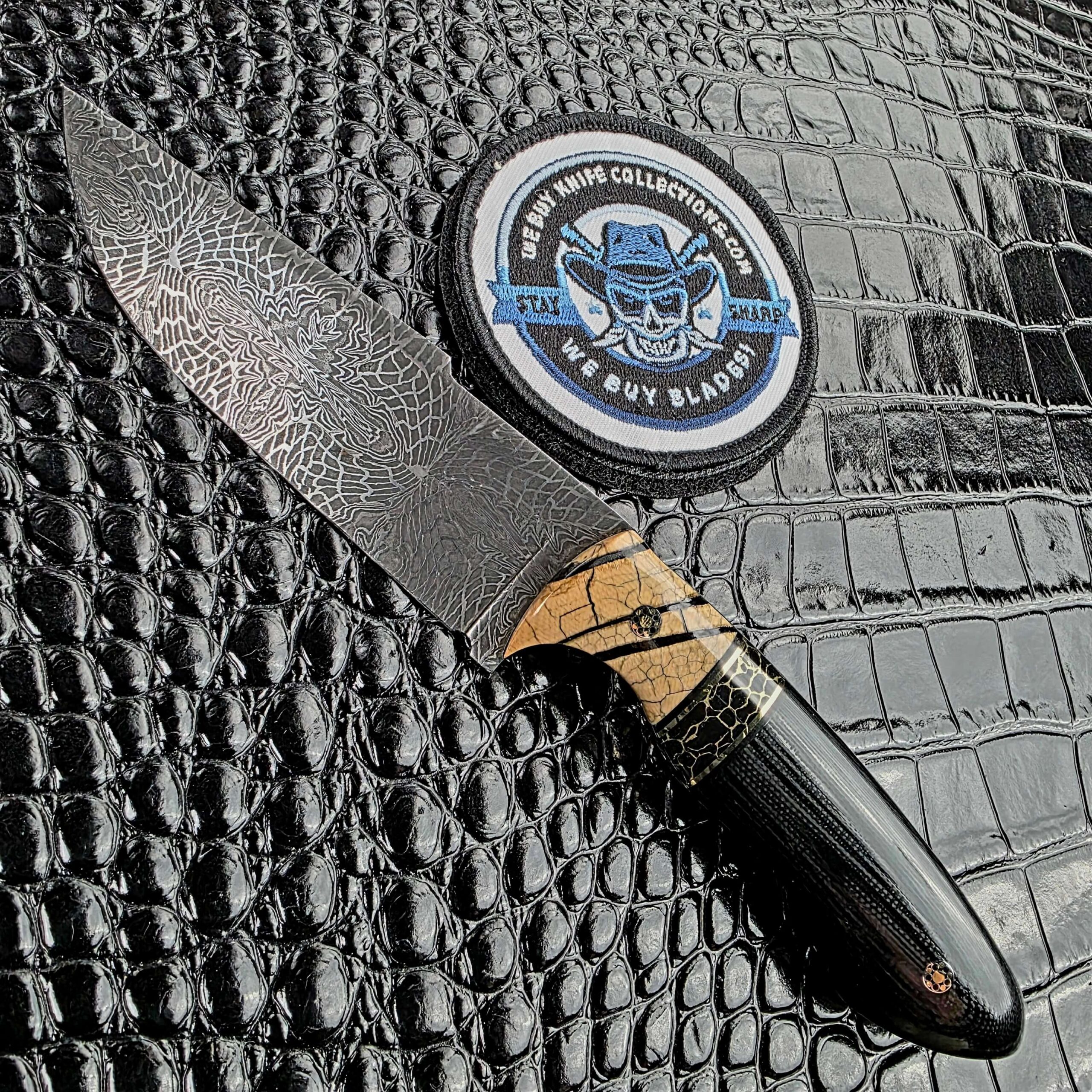
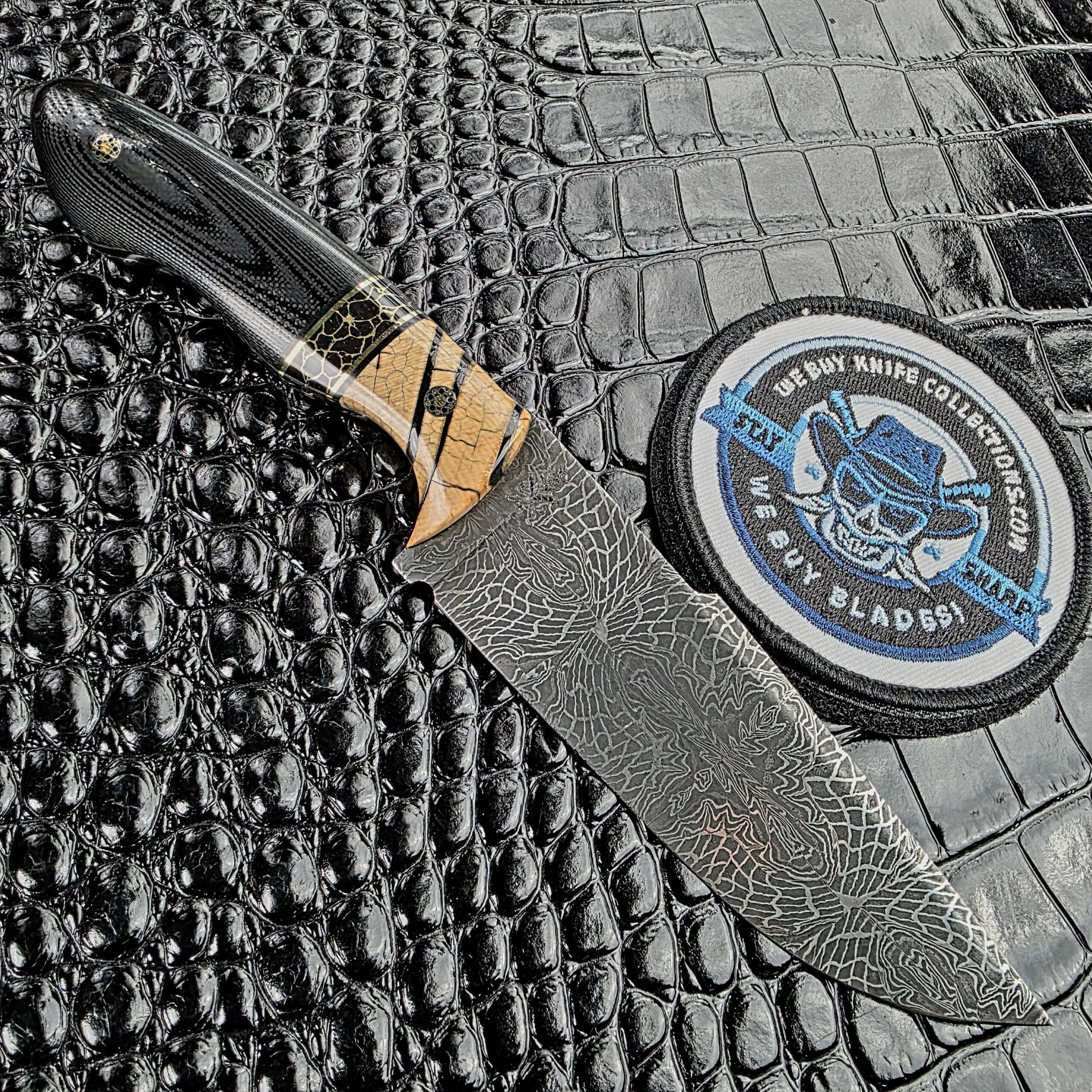
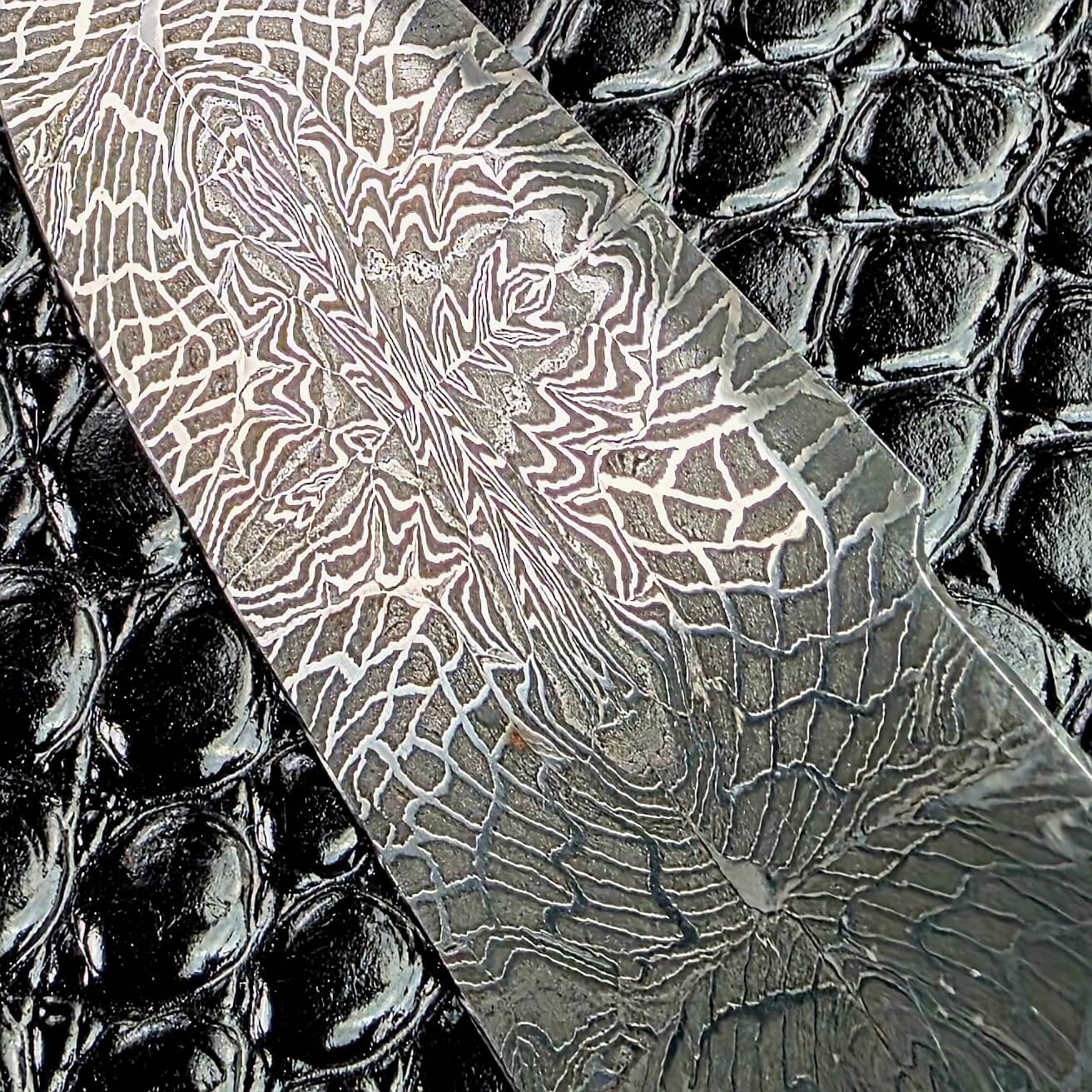
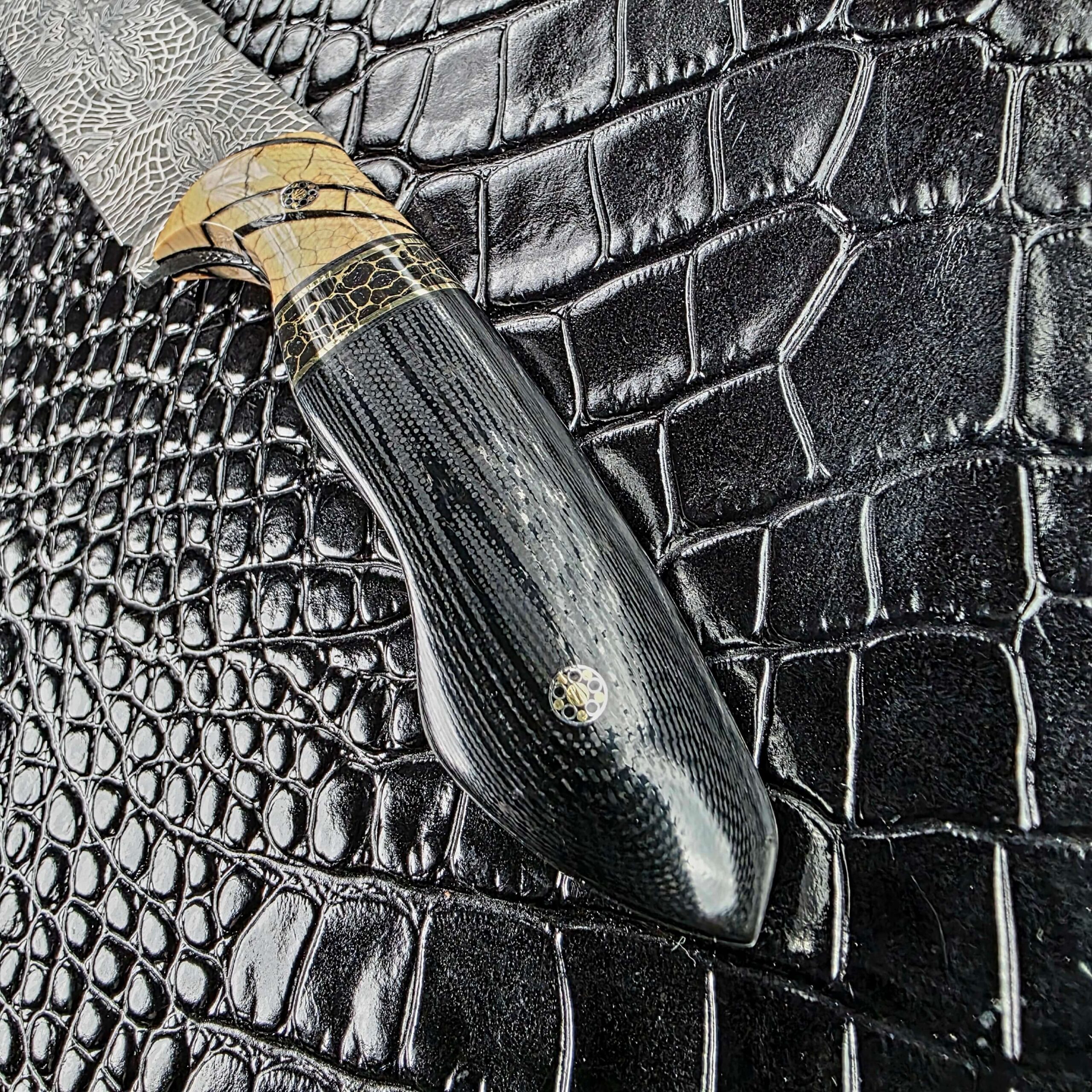
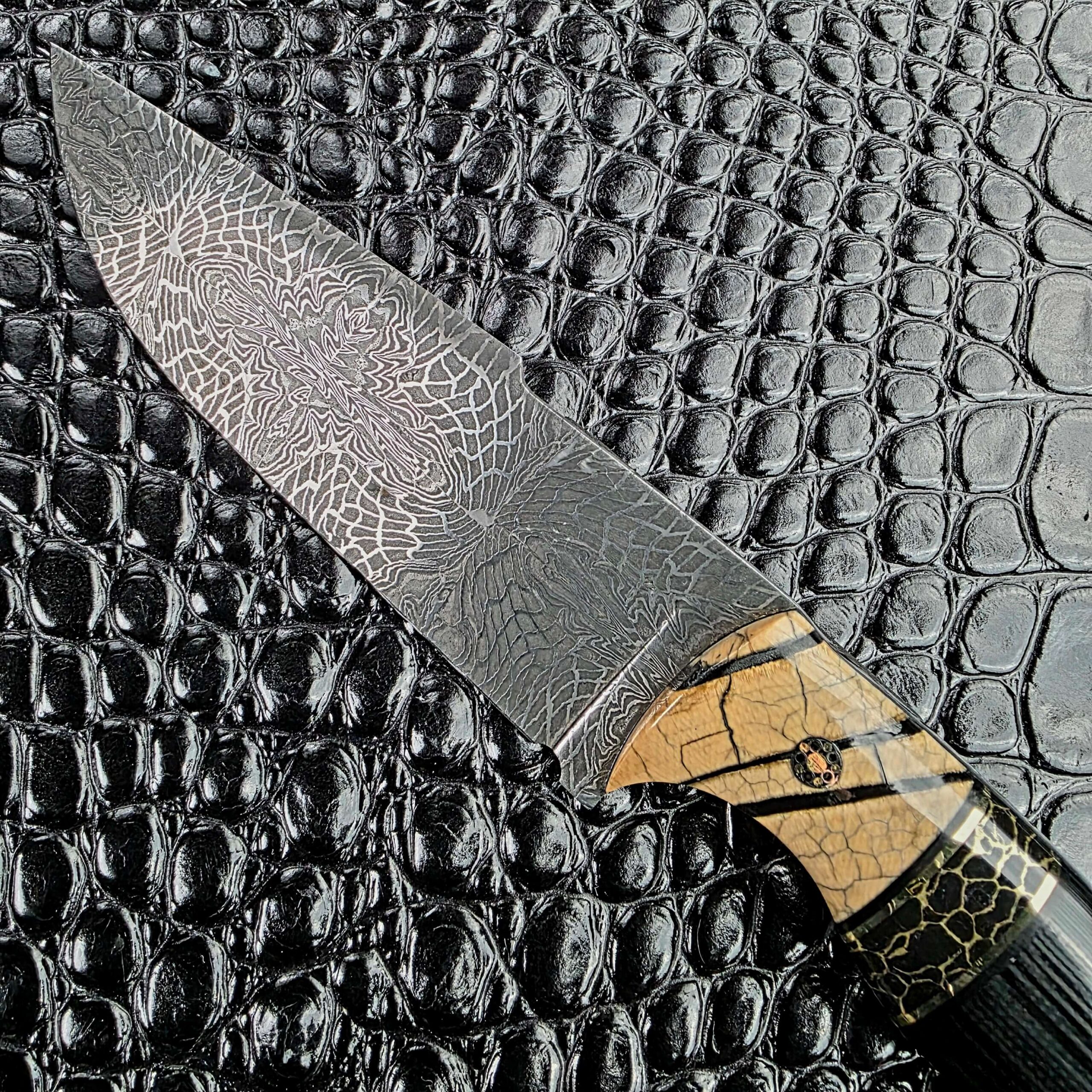
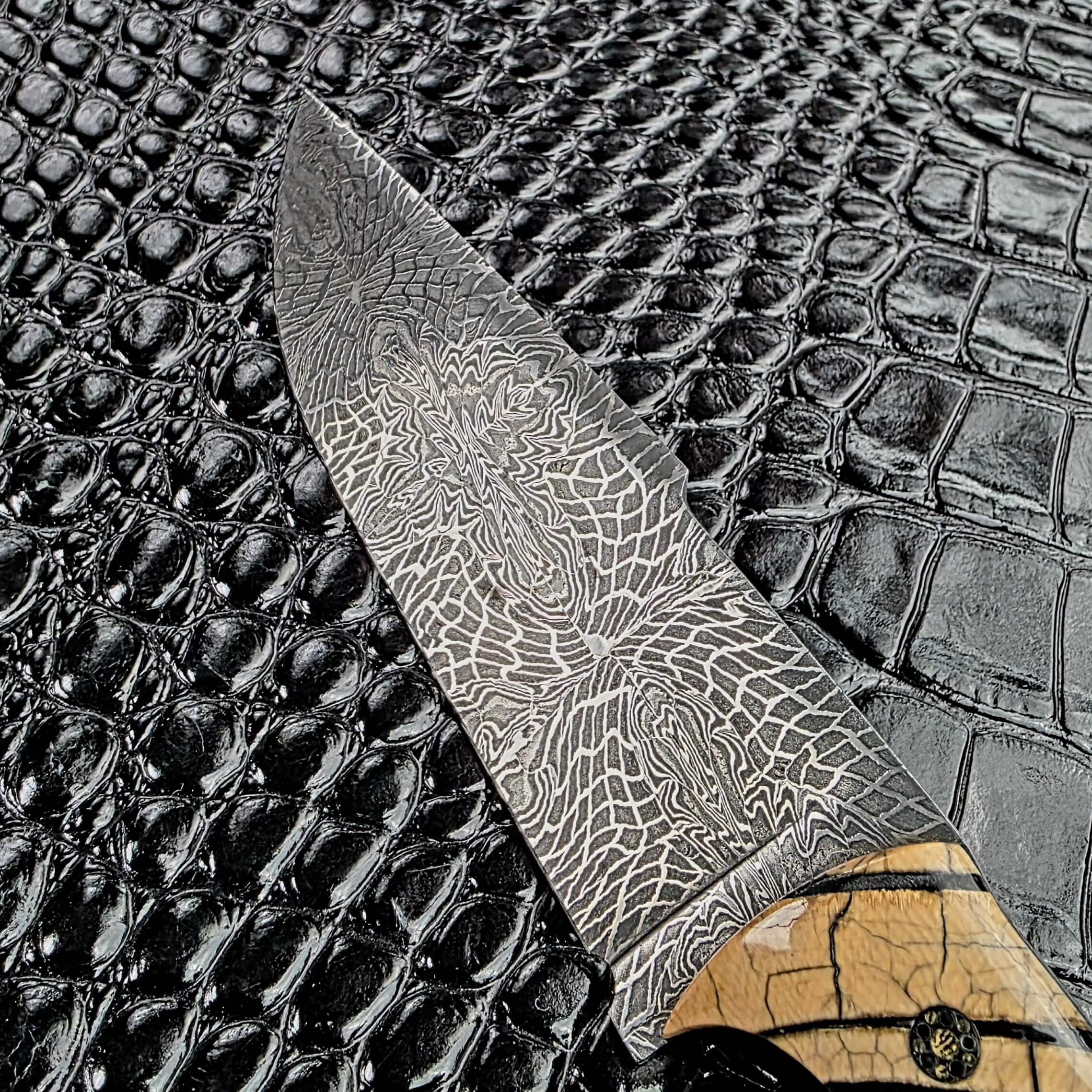
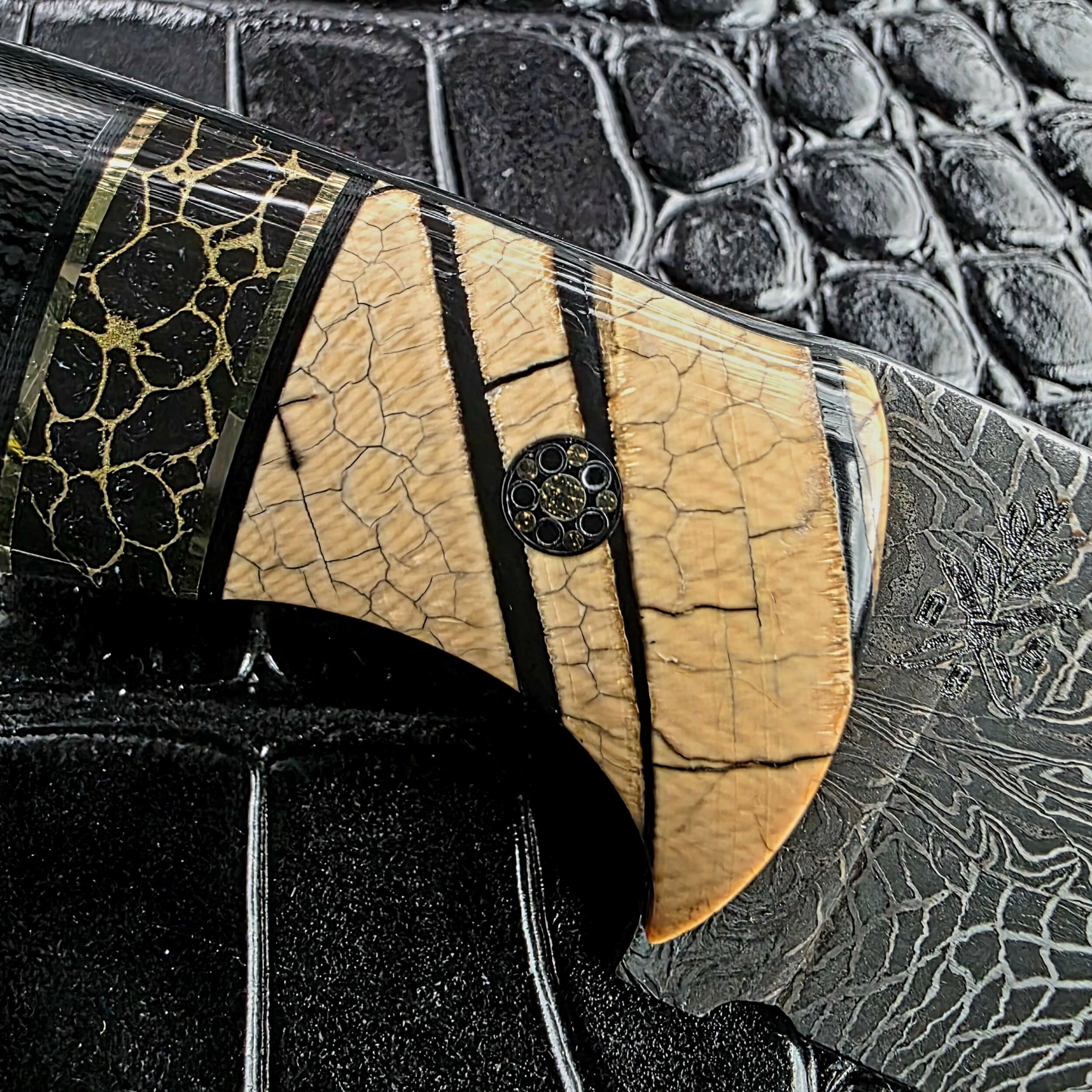
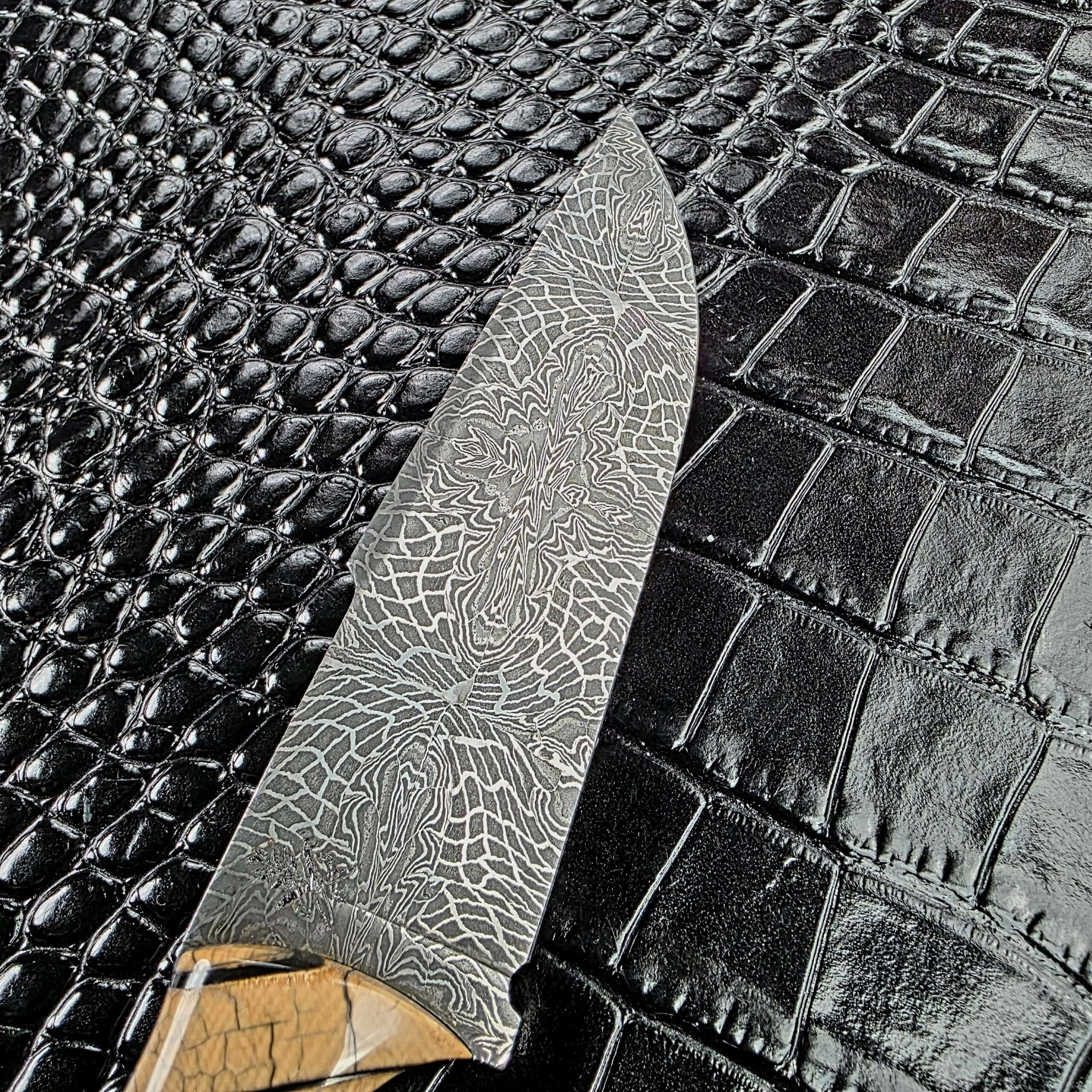
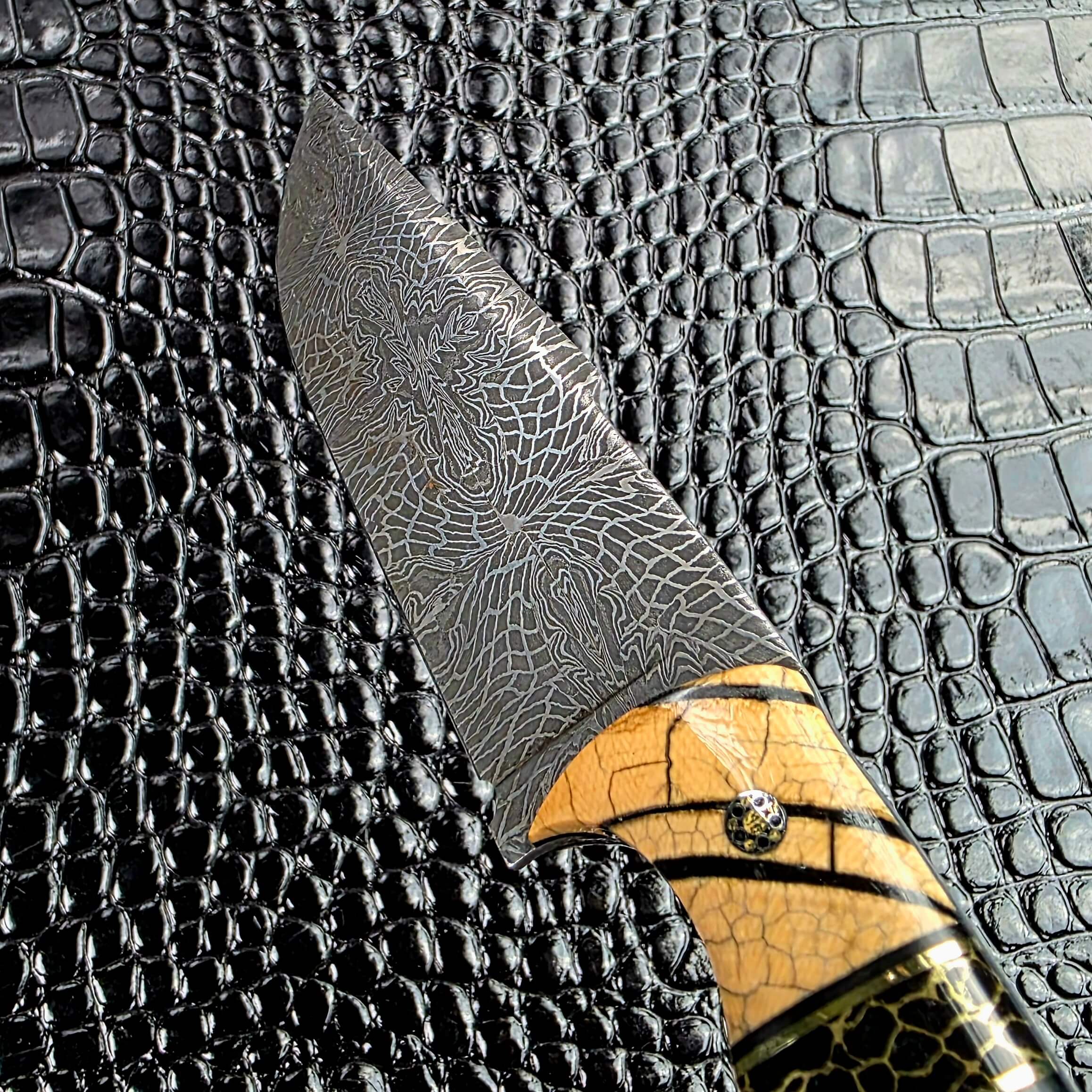
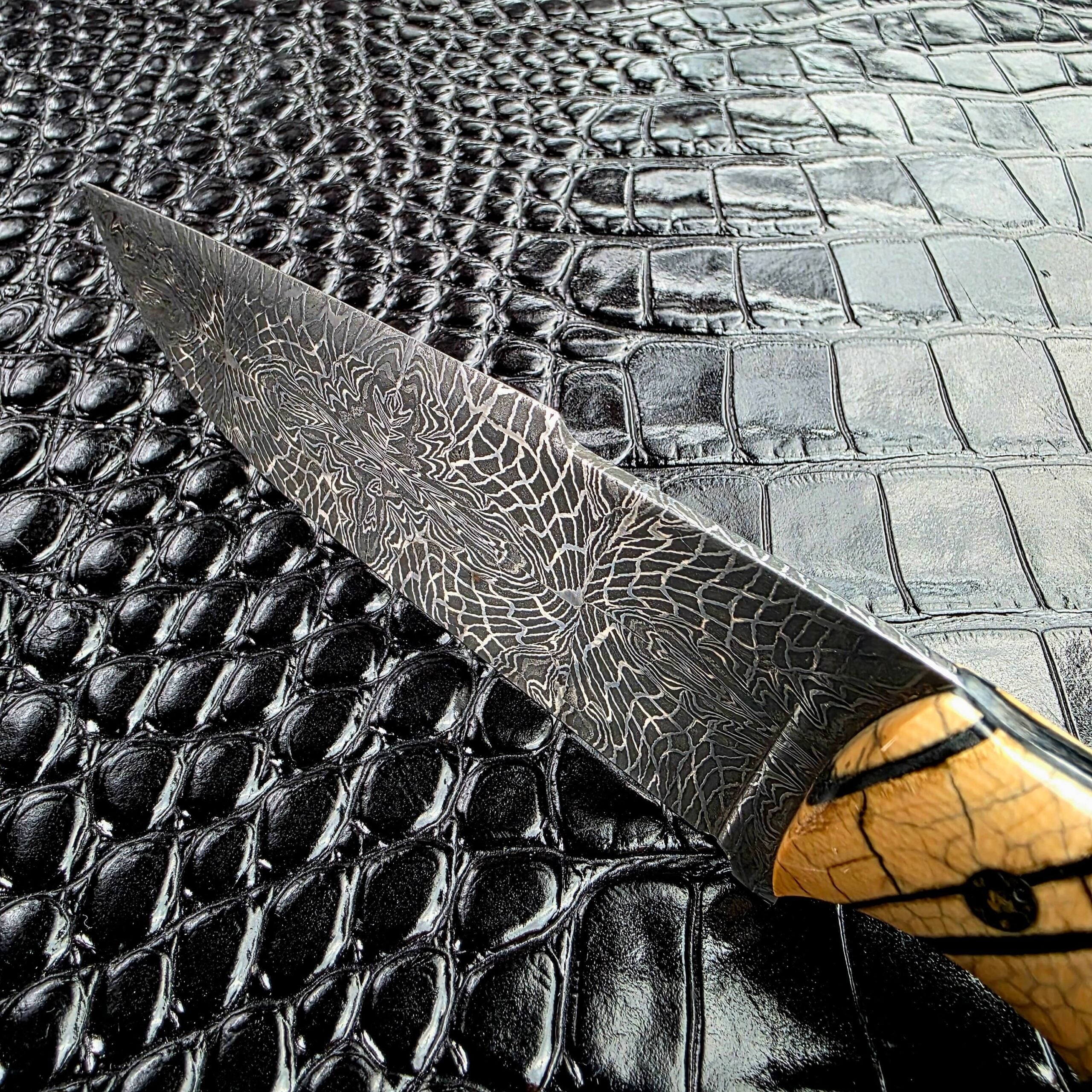
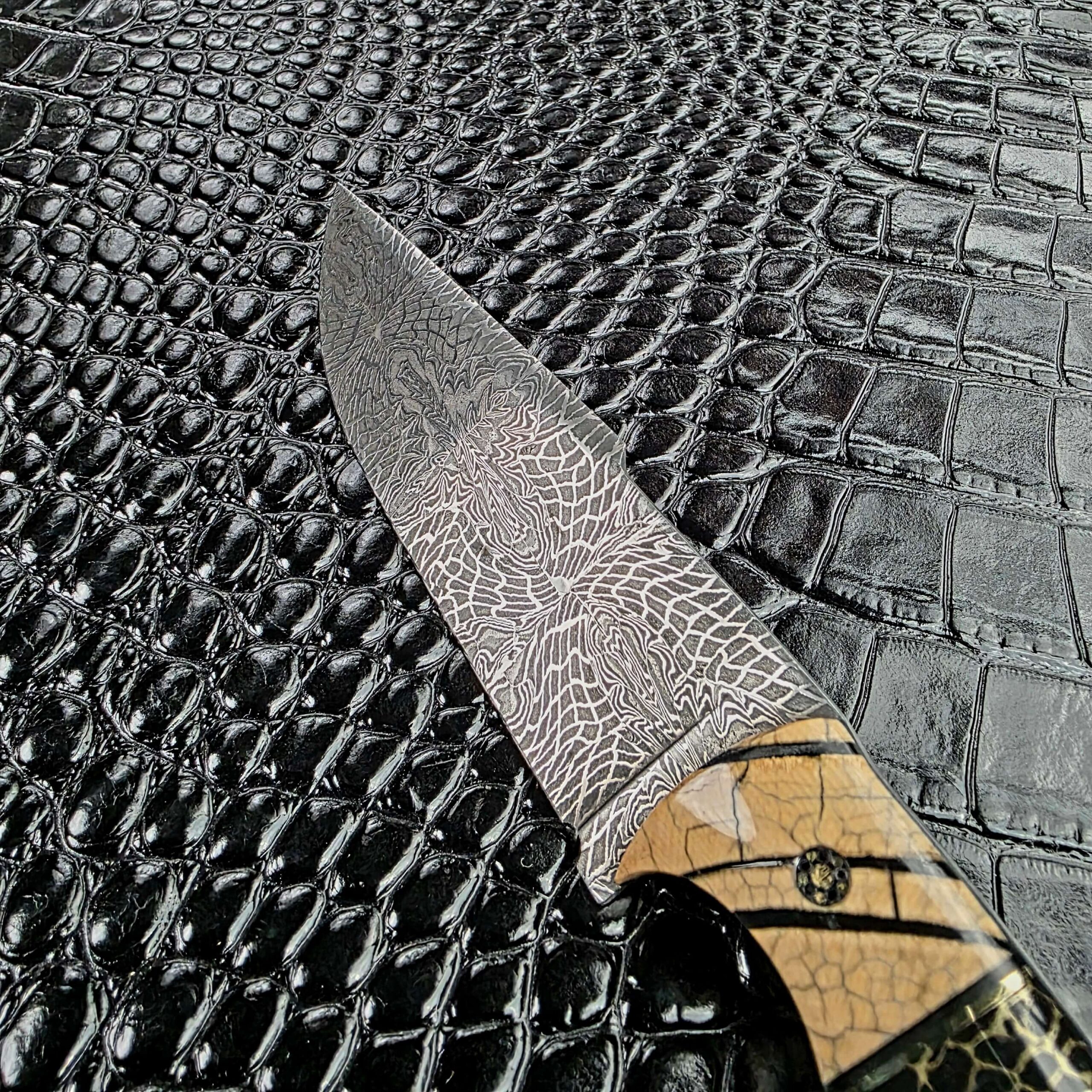
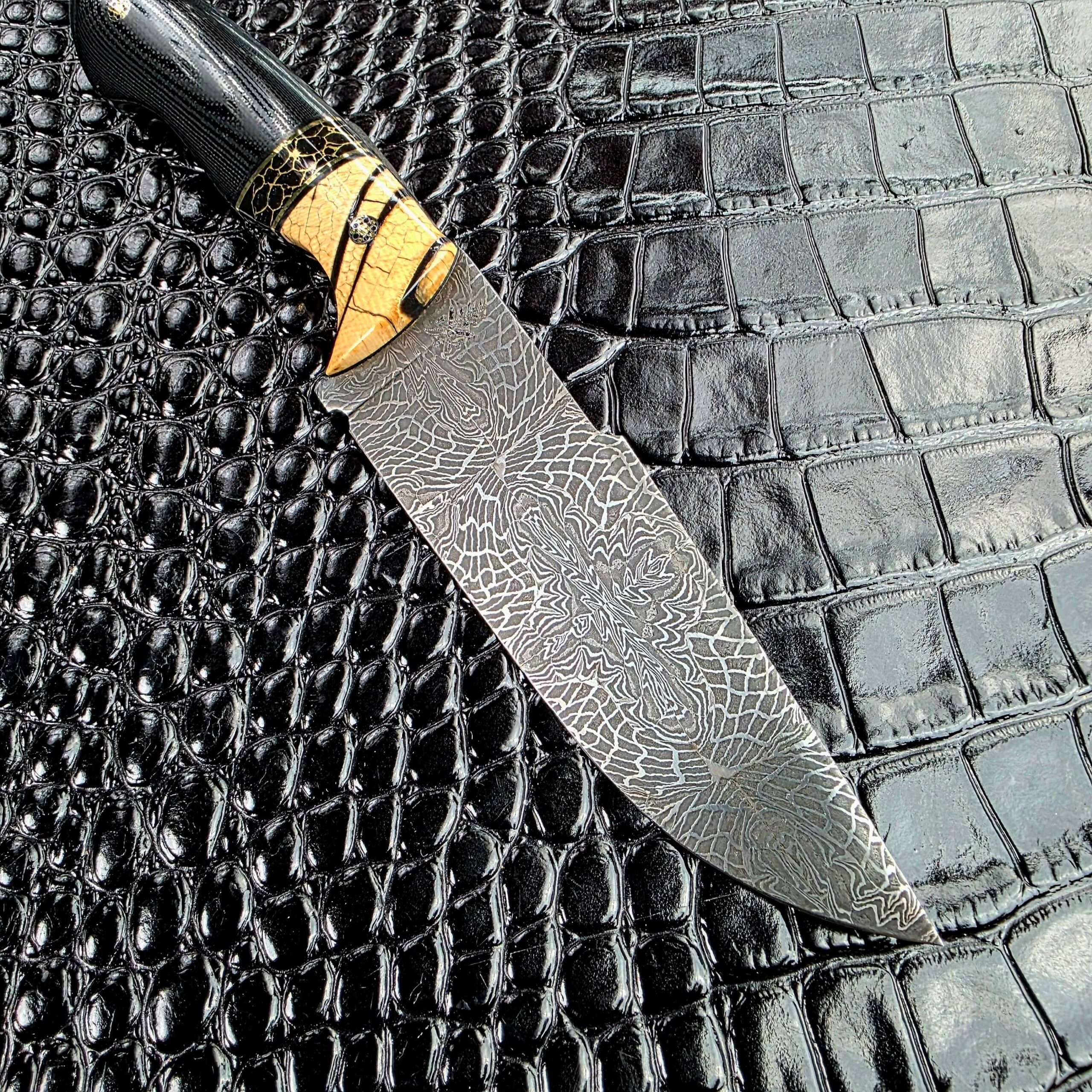
The Desert Sage Desert Dweller is a fixed blade forged in 2,500 layer mosaic Damascus. There is a cross worked into the pattern, not etched onto it. The bolsters are mammoth tusk, the handle is sculpted black G10, and an onyx Trustone inlay with a gold matrix runs through the bolster. It measures 8.5 inches overall at 6.5 ounces. Condition is new, direct from the maker.
Mosaic Damascus is not ordinary pattern welding. In standard Damascus the figure emerges from folding, and the smith takes what the billet gives him. In mosaic work the smith arranges the steel so a designed motif runs through the finished blade.
That is the hardest thing in this knife to do and the easiest thing to underestimate. Our guide on how to choose a custom knife covers what separates work like this from a production fixed blade.
2500 Layers, and Why the Count Is the Wrong Number to Watch
The billet is 80CrV2 and 15N20. The 80CrV2 is the dark steel and carries the carbon. The 15N20 is the bright one, and it is bright because its nickel content resists the ferric chloride etch that darkens everything around it.
Without that nickel there is no pattern. The layers would still be there and you would not see them.
Layer count on its own proves nothing. What it does tell you is how many forge welds the smith committed to, and every weld is a chance for the billet to fail. A 2,500 layer mosaic billet is a long sequence of simple operations where any one of them can end the piece.
Look at the cross in the photographs and then consider that it had to be placed in the billet before the steel was drawn out, and that it had to survive every operation after that.
Mammoth Tusk, Onyx Trustone and a Sculpted G10 Handle
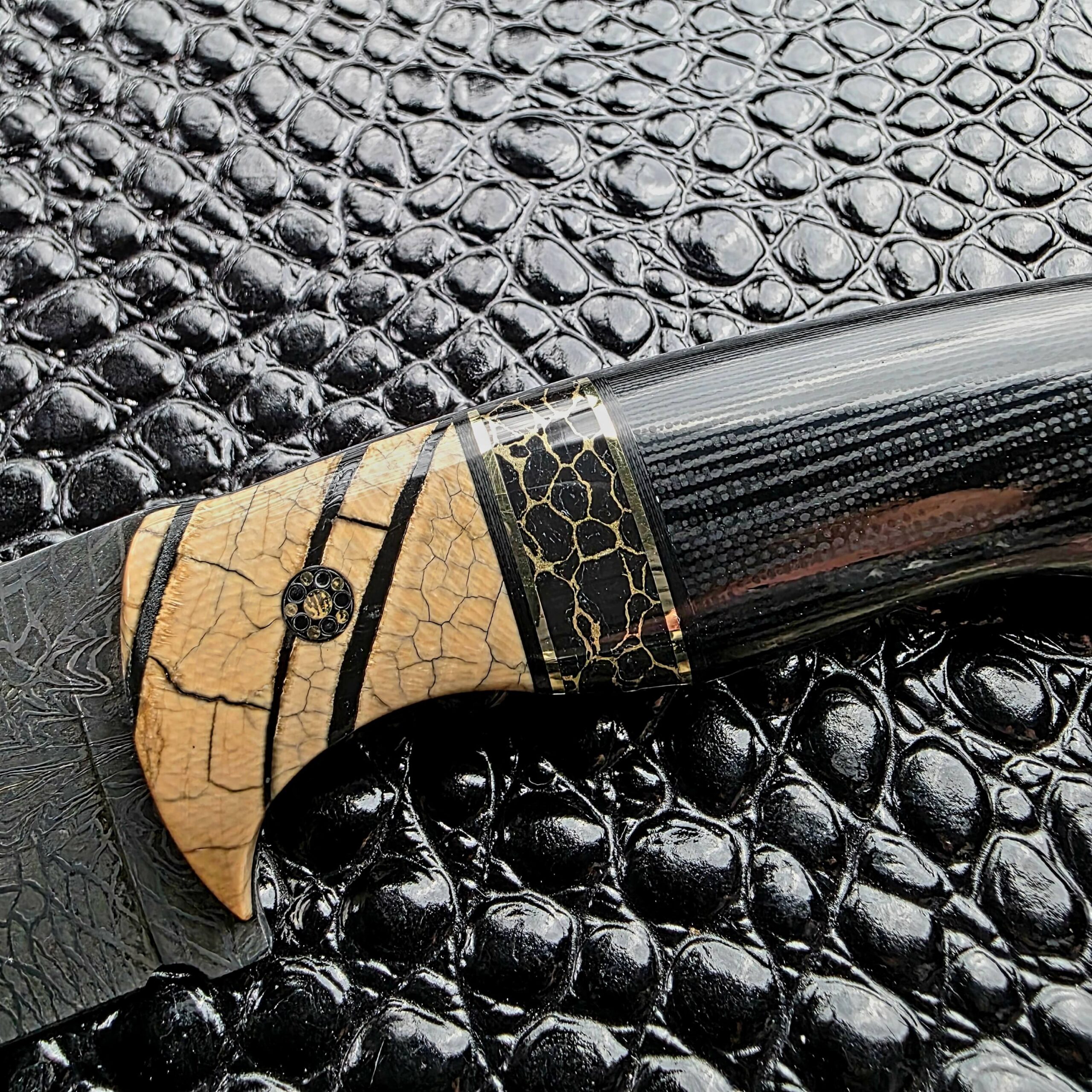
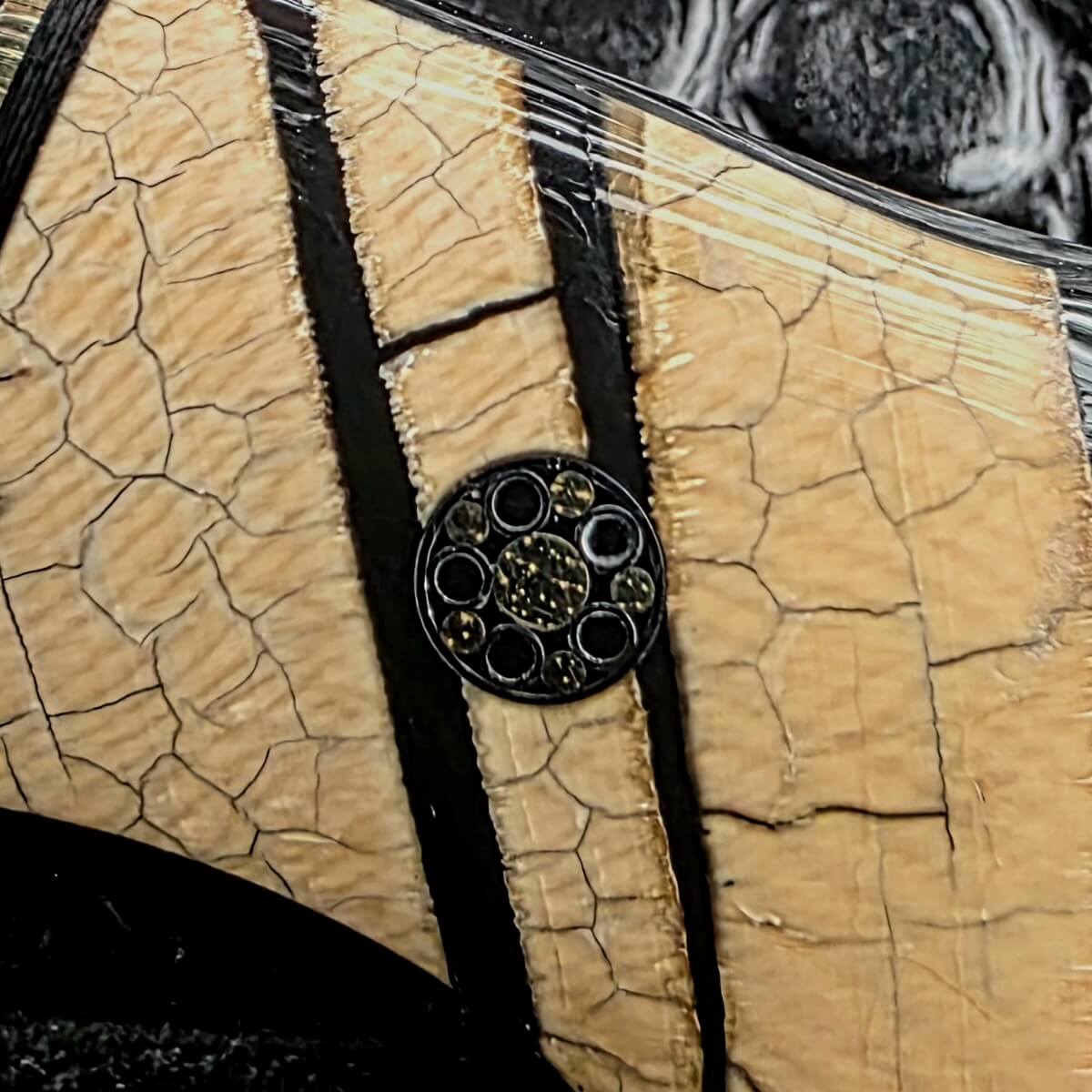
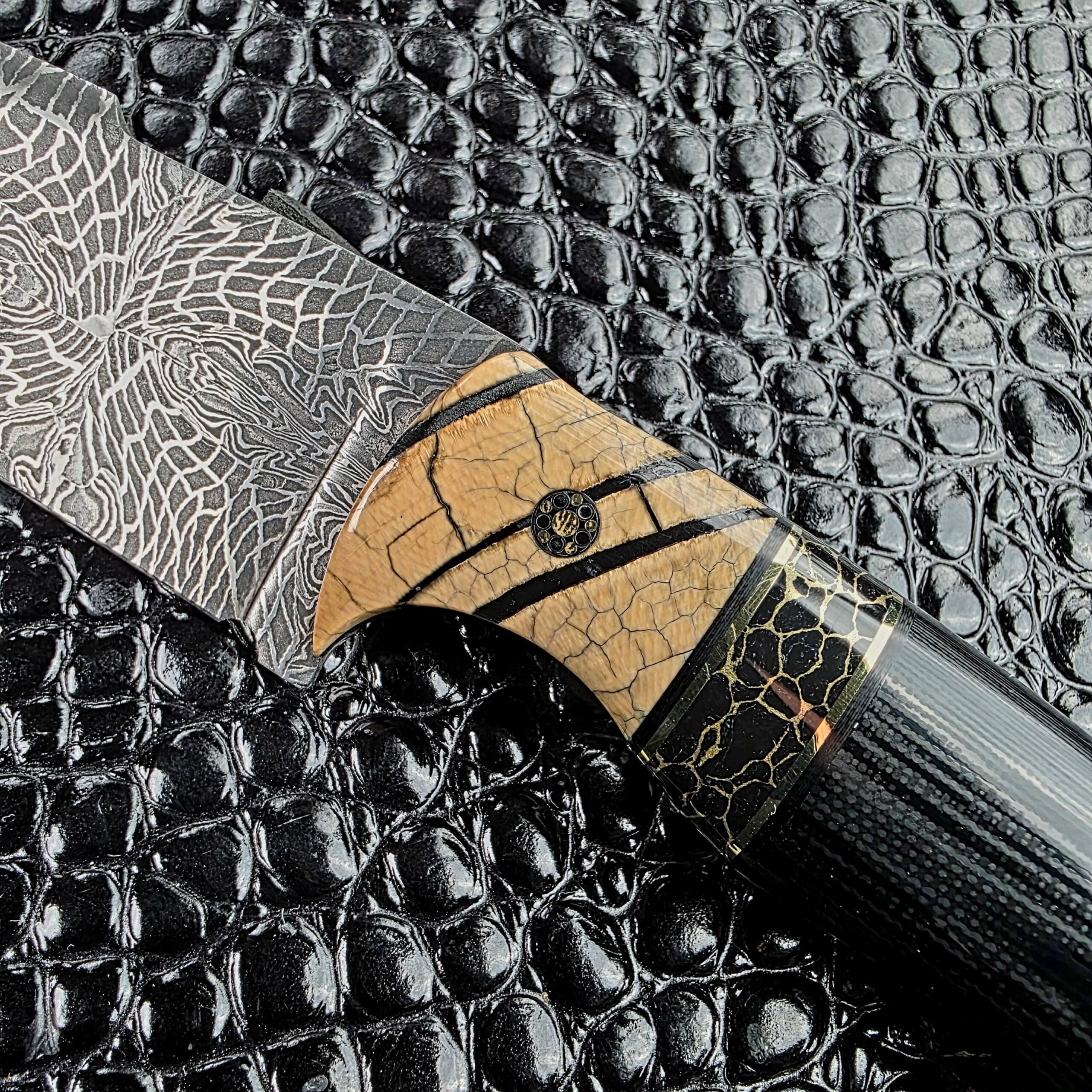
The bolsters are mammoth tusk, which is fossil material from an extinct animal rather than anything taken from a living one. The compliance notice at the foot of this page covers what that means for shipping.
Running through the bolster is an onyx Trustone inlay with a gold matrix. Trustone is stone bound in resin, which lets a maker fit a mineral into a knife handle without it behaving like a mineral. The gold veining is the matrix in the stone itself.
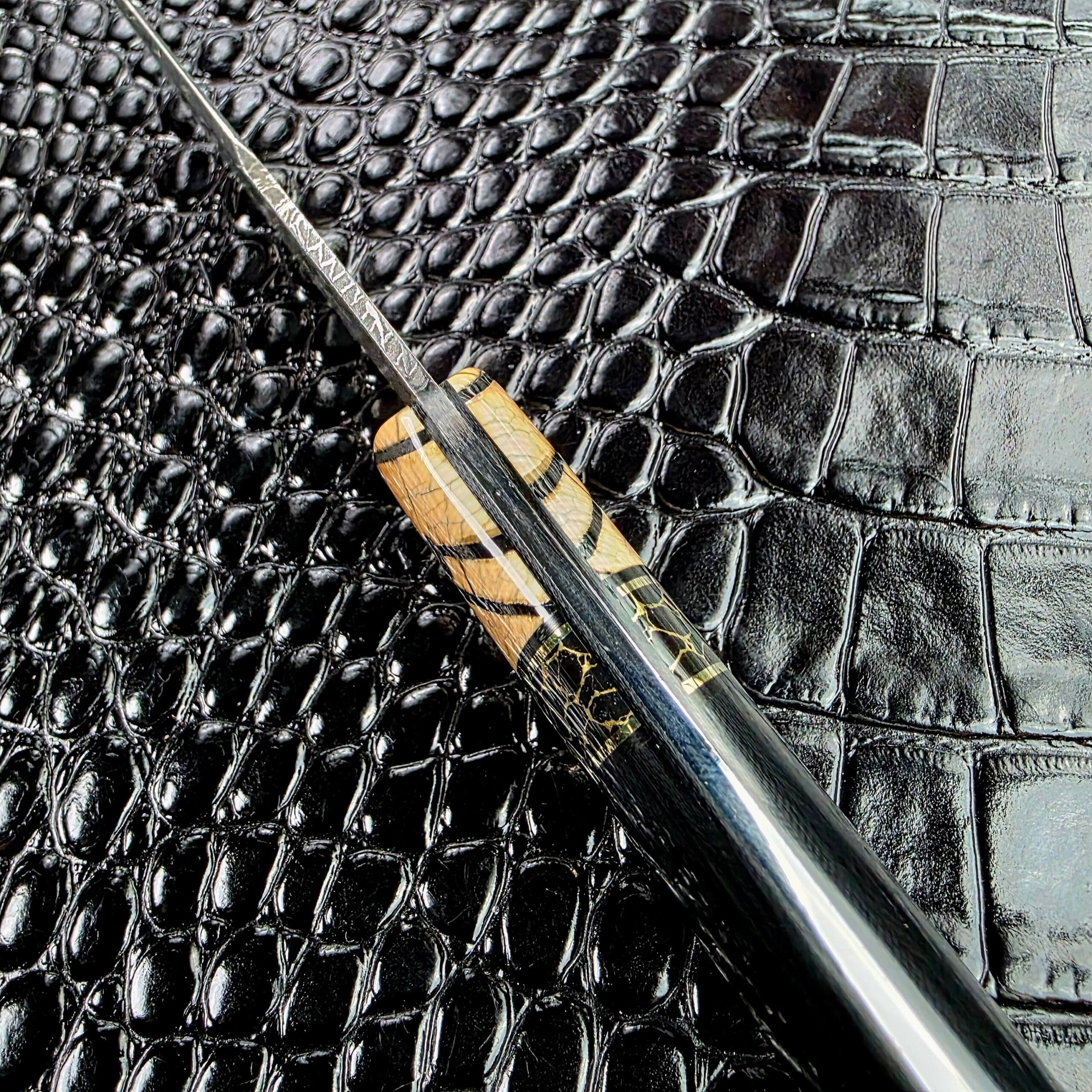
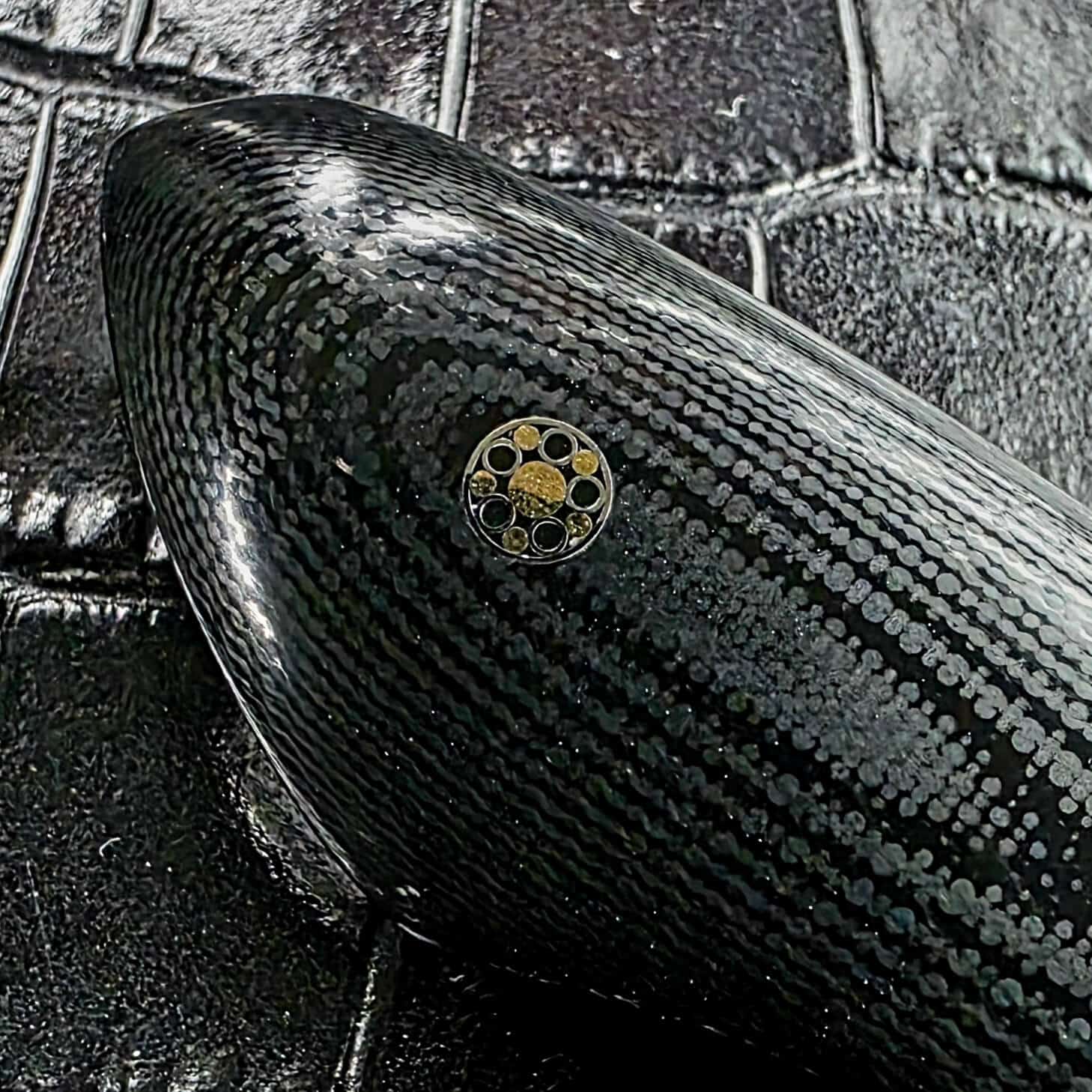
Between bolster and handle sit brass and black G10 spacers, stacked so each material reads as a separate line rather than a blur. The handle is sculpted black G10 with mosaic pins, and there is no lanyard hole at the butt.
Count the materials in one hand: damascus, mammoth tusk, onyx, brass, G10 and mosaic pin stock. Six, all fitted flush. See the rest of our fixed blades for comparable work.
Desert Sage Desert Dweller Blade and Heat Treatment
The blade is 4.25 inches with 4 inches of cutting edge, on an overall length of 8.5 inches. Handle length is 4.25 inches, so blade and handle divide the knife exactly in half.
Hardness is 60 HRC. The maker hardened it in a Hot Shot kiln and tempered it twice in a Thermo Scientific oven.
Two tempers matter. A single temper leaves retained austenite that can convert later and move the blade. Running the cycle twice converts it and then tempers what converted, which is why a maker who cares about stability does it rather than saving the hour.
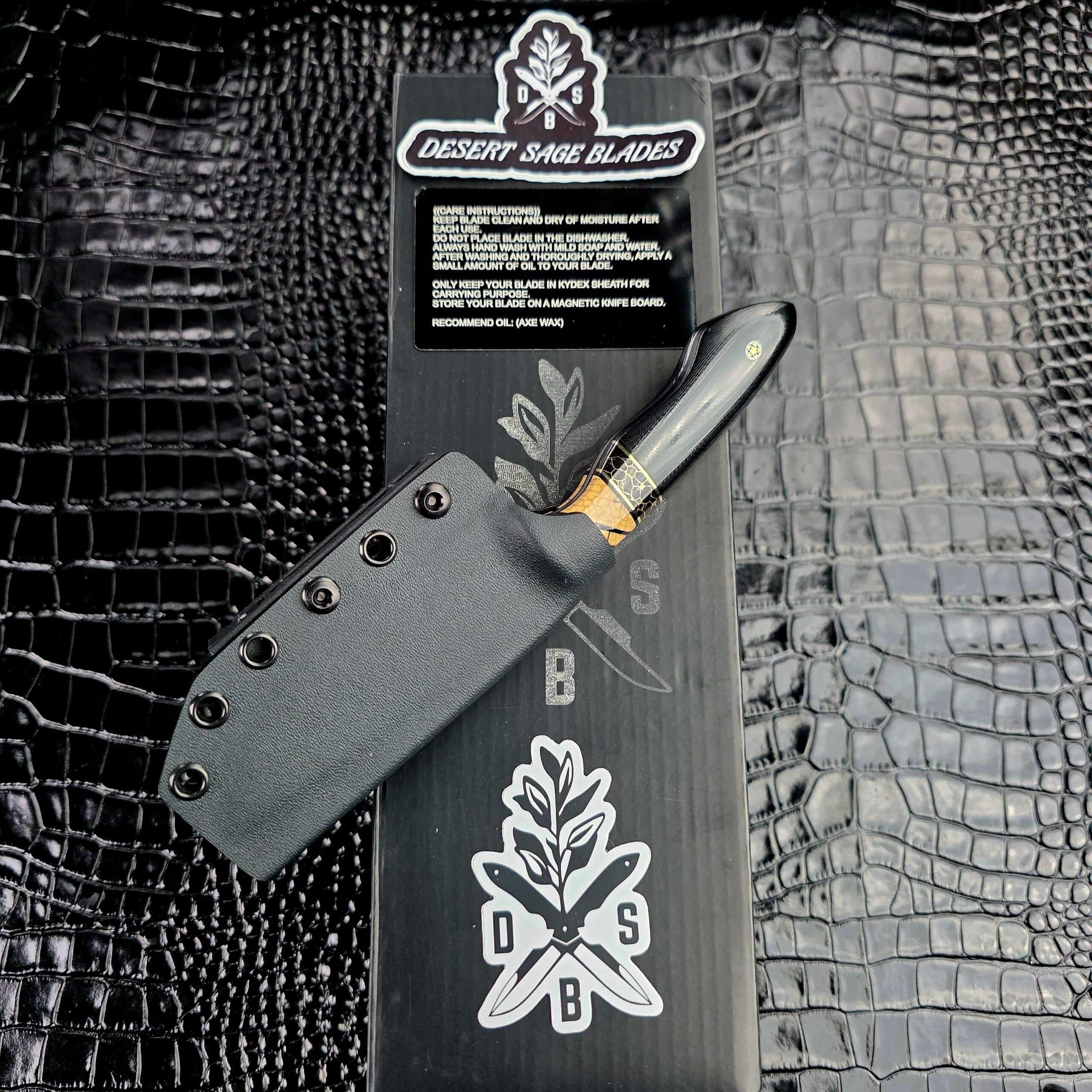
Neither steel in this billet is stainless. Both will patina, and the maker’s own care card says so plainly: hand wash, dry thoroughly, oil after drying. That is the honest cost of a Damascus this bright.
Condition and What’s Included with This Desert Sage Desert Dweller
This knife is new. It came to us direct from the maker, not through a collection, and it has never been carried or used. Our published grading standards let you check this description against what arrives.
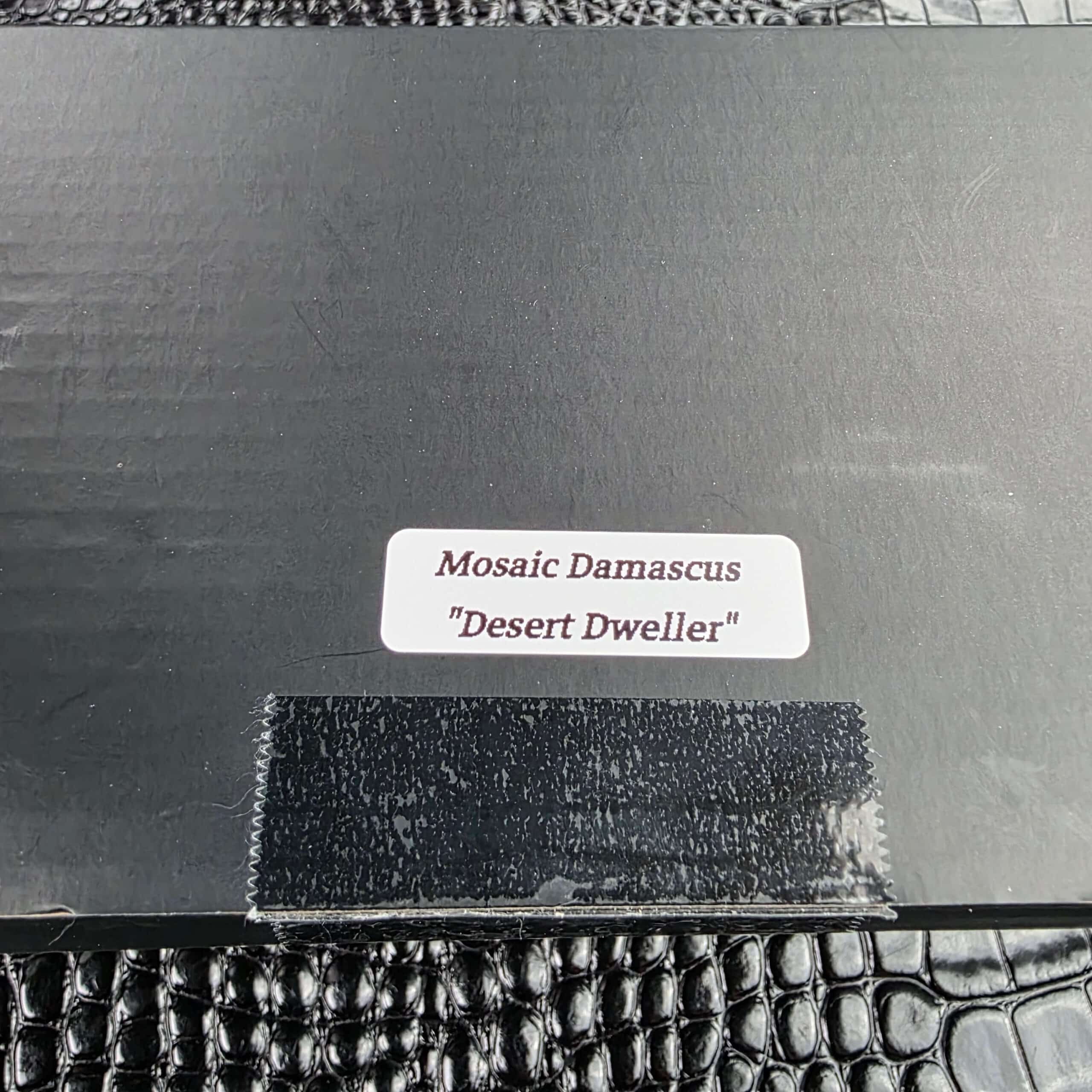
The presentation box carries the maker’s own label reading Mosaic Damascus, Desert Dweller. That is where the model name and the blade material are documented. Read how we handle provenance on pieces that arrive without a signed certificate.
The sheath is Kydex with a soft liner to protect the beautiful blade. The care card instructs carry in the sheath and storage on a magnetic board, which is the right advice for a carbon Damascus blade that should not sit against a liner in still air.
- Desert Sage Blades Desert Dweller fixed blade
- Presentation box with maker’s model label
- Kydex sheath
- Two Desert Sage Blades decals
- Contact card with care instructions
Desert Sage Desert Dweller Specifications
The model name and blade material are taken from the maker’s label on the presentation box.
- Overall length: 8.5 in
- Blade length: 4.25 in
- Cutting edge: 4 in
- Handle length: 4.25 in
- Blade material: Mosaic Damascus, 80CrV2 and 15N20, 2500 layers
- Pattern: Mosaic, including a cross motif
- Hardness: 60 HRC
- Heat treatment: Hardened in a Hot Shot kiln, tempered twice in a Thermo Scientific oven
- Bolsters: Mammoth tusk
- Inlay: Onyx Trustone with gold matrix
- Handle material: Sculpted black G10
- Spacers: Brass and black G10
- Pins: Mosaic
- Lanyard hole: None
- Weight: 6.5 oz
- Date made: August 2026
- Condition: New, unused
- SKU: 00203-DSB-DESERTDWELLER-MOSAICDAMASCUS-20260801
This one is new and available now. Browse the rest of our latest arrivals.
Video Description: Desert Dweller
The Desert Sage Desert Dweller is a new custom fixed blade in unused condition. The blade is mosaic Damascus forged from 80CrV2 and 15N20 at 2500 layers, with a cross worked into the pattern. It measures 4.25 inches with 4 inches of cutting edge. Hardness is 60 HRC, hardened in a Hot Shot kiln and tempered twice. Desert Sage Blades built it in August 2026.
The bolsters are mammoth tusk, carrying an onyx Trustone inlay with a gold matrix. Brass and black G10 spacers separate the bolster from a sculpted black G10 handle set with mosaic pins. There is no lanyard hole. Overall length is 8.5 inches with a 4.25 inch handle, at 6.5 ounces. It ships with the presentation box, a Kydex sheath, two decals and a care card.
Frequently Asked Questions
What makes mosaic Damascus different from ordinary pattern welding?
In standard Damascus the smith stacks and folds, and the figure that appears is a consequence of the process. He can steer it, but he does not draw it. In mosaic work the pattern is designed first and built into the billet, so a specific motif runs through the finished blade.
The cross on this one had to be placed in the billet and then survive every drawing, cutting and rewelding operation after that. It is among the most technically demanding work in bladesmithing, and it is why mosaic pieces carry a premium over random pattern Damascus of the same layer count.
Does a 2500 layer count mean a better blade?
Not on its own, and anyone selling you layer count as a quality measure is selling you the wrong number. Weld integrity, steel selection, heat treatment, grind and design all matter more.
What the count does tell you is exposure. Each layer represents forge welds the smith committed to, and every weld is an opportunity for a cold shut or a delamination that ruins the billet. A high count is a statement about risk accepted, not about edge performance.
Why 80CrV2 and 15N20 specifically?
The pair is chosen for contrast as much as performance. 80CrV2 is a tough high-carbon steel that etches dark. 15N20 carries roughly two percent nickel, which resists the ferric chloride etch and stays bright.
Put them together and the etch does the drawing for you. Without a nickel-bearing steel in the stack the layers exist but the pattern does not appear. Neither is stainless, which is why the maker supplies a care card rather than assuming.
Why temper twice?
Quenching leaves some austenite untransformed in the blade. A first temper converts a portion of it to fresh, un-tempered martensite, which is hard and brittle and sitting in the steel unaddressed.
The second cycle tempers what the first one created. Skipping it leaves a blade that can move or become brittle later. It costs the maker an hour and it is one of the clearest signals that someone is building for stability rather than for the invoice.
What is Trustone, and how does it sit next to mammoth tusk?
Trustone is genuine mineral, in this case onyx, bound in resin so it can be machined, pinned and finished like a handle material instead of fracturing like stone. The gold matrix is veining in the onyx itself rather than an added metal.
Pairing it with mammoth tusk is a deliberate contrast. One material is fossil organic and warm, the other is mineral and cold, and the brass and G10 spacers between them keep each line separate rather than letting them run together.
Does We Buy Knife Collections actively support the broader knife enthusiast community?
Yes. Based in Jacksonville, Florida, We Buy Knife Collections is a curator and purveyor of fine custom made folding and fixed-blade knives. We are dedicated to the high-end custom knife community and we support knife rights advocacy.
Following our commitment upgrade in April 2026, we are proud to hold an AKTI Premier Membership, supporting the American Knife & Tool Institute’s vital advocacy and lobbying for knife owners, makers, and the future of the industry.
Buy This Desert Sage Desert Dweller
We inspect every knife in hand and photograph it ourselves. This is the first Desert Sage Blades piece we have carried. Talk to us about selling your collection, or browse our direct from maker knives.
Mammoth Ivory Compliance Notice
The mammoth material on this knife is fossilized mammoth, not elephant ivory. No living or endangered animal is involved.


Reviews
There are no reviews yet.