
Dew Hara Custom Knives
- 3LegDog Knives (1)
- 417CNC Knives (1)
- A2 Knives (1)
- Allen Elishewitz Custom Knives (3)
- André Thorburn Custom Knives (2)
- Andriy Mozil Custom Knives (3)
- Anton van der Westhuizen Custom Knives (1)
- Arno Bernard Knives (2)
- Bill Coffey Custom Knives (1)
- Bill Poor Custom Knives (1)
- Billy Mace Imel Custom Knives (2)
- Blackside Customs (5)
- Borka Blades & Sebastijan Berenji (2)
- Brandon Vallotton Custom Knives (2)
- Brian Milinski Custom Knives (1)
- Brian Tighe Custom Knives (2)
- Brown Knives by Craig Brown (3)
- Buddy Gaines Custom Knives (1)
- Burn Knives by Paul Panak (5)
- Chris Reeve Knives (12)
- Chuck Gedraitis Custom Knives (3)
- Clark Blades by David Clark (1)
- Corrie Schoeman Custom Knives (1)
- Curt Zimmermann Custom Knives (3)
- Curtiss Knives (1)
- Custom Knife Factory (CKF) (7)
- Darac Steel & Dario Zadravec (1)
- Daryl Hibben Custom Knives (1)
- David Broadwell Custom Knives (2)
- DDR Knives - Darrel Ralph (2)
- Dervish Knives - John Gonzalez (2)
- Desert Sage Blades (1)
- Dianna Casteel Custom Knives (1)
- Direware Knives (1)
- DSK Tactical (3)
- Eliot "E.F." Maldonado Custom Knives (2)
- Emerson Knives (1)
- FengLi (1)
- Ferrum Forge Knife Works (1)
- Fischer Brothers Custom Knives (1)
- Francois du Toit Custom Knives (1)
- Glenn Are Hovin Custom Knives (2)
- Glenn Waters Custom Knives (2)
- Greg Lightfoot Custom Knives (1)
- Grimsmo Knives (3)
- Half Face Blades (3)
- Hawk Knife Designs (5)
- Haymaker Customs (1)
- Heretic Knives (7)
- Herman Knives (4)
- Herucus Blomerus Custom Knives (1)
- Hog House Knives (4)
- Holley Knife Company (2)
- Holt Bladeworks (1)
- Hoss Knives (2)
- Hypercut Manufacturing - Dylan Davis (3)
- J.B. Stout & Stout Knife & Tool (1)
- Jaco De Kock Custom Knives (4)
- Jason Clark & Clark Custom Knives (2)
- JD Van Deventer Custom Knives (1)
- Jeff Chaffee Custom Knives (1)
- Jeff VanderMeulen Custom Knives (1)
- Jerry Hossom Custom Knives (1)
- Jim Sornberger Custom Knives (1)
- JKK Custom Knives by Jen Lint (1)
- John Gray Custom Knives (4)
- KC Gray Custom Knives (1)
- Keanison Knives (1)
- Keith Kruger Custom Knives (1)
- Kit Carson (1)
- Koenig Knives (3)
- Koji Hara Custom Knives (3)
- Kyle Vallotton Custom Knives (1)
- La Cantina Knives (1)
- Larry Pridgen Custom Knives (1)
- Les George Knives (1)
- Lone Wolf Knives (1)
- Maniac Machining (3)
- Marfione Custom Knives (7)
- Medford Knife & Tool (1)
- Mel Pardue Custom Knives (1)
- Melvin Lozada Custom Knives (4)
- Michael Zieba Custom Knives (1)
- Microtech Knives (6)
- Miroc Blade Works (1)
- Munroe Metalworks Custom Knives (1)
- NADEN Knives by Fellhoelter & Willumsen (1)
- NCC Knives (1)
- Neels van den Berg (Black Dragon Forge) (1)
- Nicholas Nichols Knives (1)
- NOC Knives (1)
- Olamic Cutlery (2)
- Pat Crawford Custom Knives (1)
- Patrick Famin Custom Knives (4)
- Poikilo Blade (1)
- Prince Customs (1)
- ProTech Knives (2)
- Rainy Vallotton Custom Knives (2)
- Randy Doucette Custom Knives (1)
- Ray Laconico Custom Knives (1)
- Reese Weiland Custom Knives (11)
- Rick Barrett Custom Knives (2)
- RMOR Knives (2)
- Robjohnsons Custom Knives (1)
- Rockstead Knives (2)
- Scorpion 6 Knives (5)
- Scott Gallagher Custom Knives (2)
- Sergey Rogovets Custom Knives (1)
- Shane Atwood & Atwood Custom Knives (3)
- Sharknivco Knives (1)
- Shirogorov Knives (2)
- Simeon Custom Knives (1)
- Skiff Made Blades (2)
- Stefano Compostella Custom Knives (2)
- Strider Knives (3)
- Tim Britton Custom Knives (1)
- Tuch Knives (1)
- ViKnives Customs by Victor Barajas (1)
- W. Guinn Custom Knives (1)
- William Henry Knives (1)
- Yan Knives (1)
Showing 1–12 of 23 resultsSorted by latest
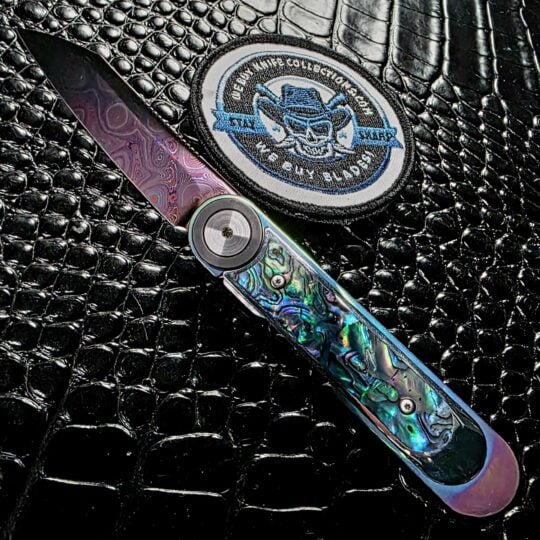


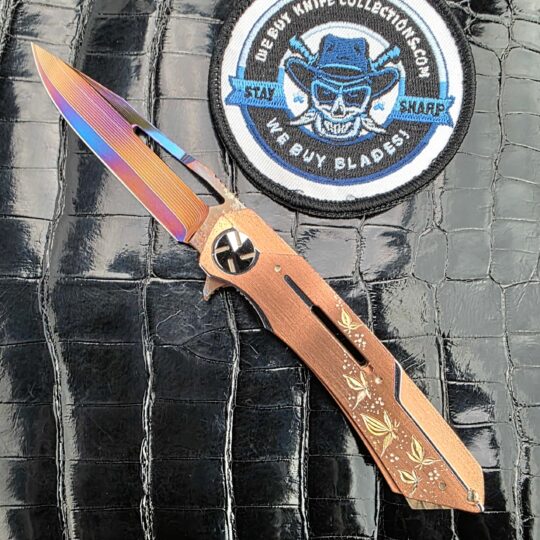
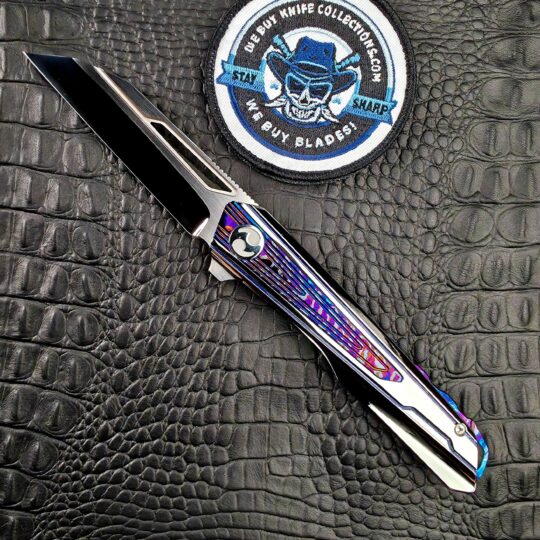
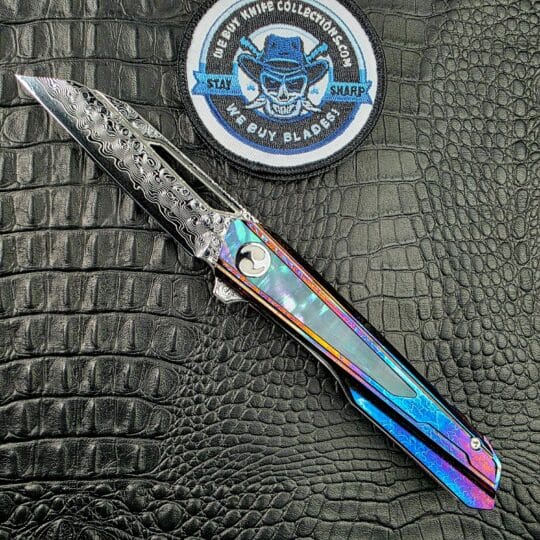
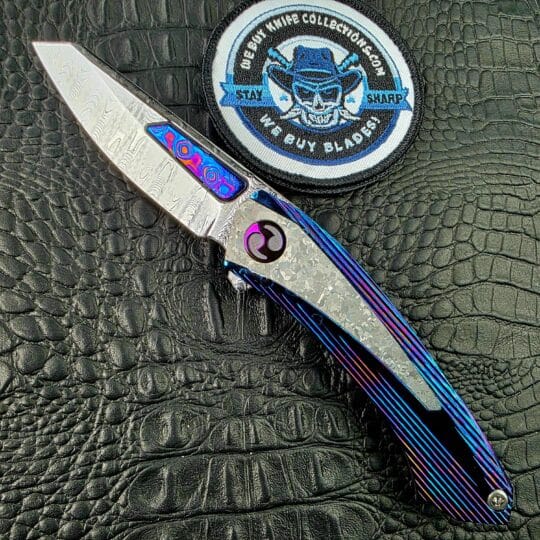
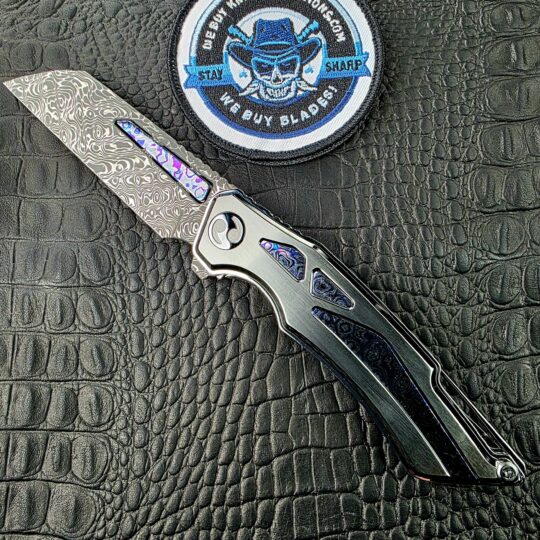


Dew Hara Custom Knives: Japanese Tactical Art and Precision
Dew Hara Custom Knives combine the refined finishing traditions of Seki, Japan, with distinctive modern folding-knife design. The maker, Ryuichi “Dew” Hara, is the son of respected custom knifemaker Koji Hara. Yet Dew has developed an unmistakable style of his own: angular profiles, layered titanium construction, elaborate inlays, and striking blade finishes.
His work ranges from streamlined folders to highly individualized collector pieces. Consequently, enthusiasts can explore both mechanical design and decorative metalwork within one maker’s catalog. The family connection also introduces collectors to Koji Hara Custom Knives and Japan’s custom knife tradition.
From Koji Hara’s Workshop to Microtech
Dew grew up around his father’s knifemaking, but his professional path was not immediate. Before entering the trade full-time, he worked in photography and web design. He later assisted Koji and pursued further training in the United States.
In 2015, Dew trained at Microtech under Tony Marfione. He returned to Japan and became a full-time custom knifemaker in 2016. That experience helped unite close-tolerance machining with the hand-finishing skills associated with Japanese art knives. His approach is distinct from his father’s, favoring bold mechanical forms over more traditional ornament.
His design work also reached a wider audience through CRKT’s Raikiri, introduced as a production interpretation in 2018. The model incorporated CRKT’s Field Strip technology. This chapter demonstrates how Dew’s ideas extend beyond individual handmade customs.
NOAH and NOAH-ZEN: Architectural Japanese Custom Folders
The NOAH is one of Dew’s defining designs. In a published interview, he traced its inspiration to an architectural proposal for a national stadium. Its strong lines and sculpted handle geometry reflect that influence, creating a folder with unusual depth and structure.
NOAH configurations vary in their blades, frames, and decorative materials. Examples include titanium construction, polished M390, colorful abalone, and Damascus. The related NOAH-ZEN line explores different finishes and inlays, including a documented NOAH-ZEN DH-20B custom folder. Each individual knife merits evaluation on its own specifications.
GAIA: Compact Geometry and Individualized Finishes
GAIA brings a more compact silhouette to the lineup without losing Dew’s sculptural approach. Angular blade geometry, carefully shaped titanium, and decorative treatments give its examples a recognizable identity. In particular, collectors can compare numbered builds to study how the same design changes with materials.
The GAIA serial 002 pairs M390 with DLC finishes and a Zircuti inlay. Other documented examples introduce abalone, Cosmic Storm titanium treatments, or a different blade finish. The model illustrates how a recurring design can retain individual collector character.
RAY and METEOR: Damascus, Zircuti, and High-Contrast Art
The RAY and METEOR explore the more dramatic side of Dew Hara’s work. Both appear in configurations that combine complex blade patterns with expressive handle materials. Depending on the build, collectors may encounter titanium, Zircuti, Timascus, abalone, DLC, and multi-layer Damascus.
One documented RAY one-of-one custom combines Seismic stainless Damascus with Zircuti details and a DLC titanium handle. Meanwhile, a METEOR with Sharktooth Damascus pairs patterned steel with Timascus and crystallized titanium. These are documented individual configurations, not standard specifications for every knife in either series.
Chronos, Infinity, Kabuki, and Homura
The broader catalog shows that Dew does not rely on one handle shape or blade profile. Chronos models combine sleek outlines with elaborate finishes. For instance, a Chronos Dark Lightning custom uses VG-10 Damascus, Timascus inlays, and mirror-polished titanium.
The Infinity front flipper introduces another approach to blade geometry and deployment. Kabuki models offer additional combinations of polished steel, Damascus, and decorative inlays. The Homura fixed blade extends the lineup beyond folders, with a Japanese-inspired profile and distinctive finishing details.
Materials, Construction, and Collector Evaluation
Dew’s knives invite close inspection beyond their appearance. Blade steel can range from M390 to VG-10 Damascus and other laminated or patterned steels. Handles may combine titanium with carbon fiber, abalone, Timascus, Zircuti, or pearl. Coatings and polishing methods also vary substantially between examples.
Moreover, a one-of-one designation describes a particular configuration; it does not automatically establish investment value. Collectors should assess blade centering, lockup, finish originality, inlay fit, hardware, and included maker documentation. WBKC explains its approach to condition grading and knife provenance.
Buying and Selling Dew Hara Custom Knives
For collectors, these knives offer a combination of Japanese maker heritage, identifiable design language, and substantial variation between builds. WBKC documents individual examples through detailed photographs, specifications, condition information, and available original accessories. Buyers can explore custom folding knives alongside the maker’s catalog.
Owners considering a sale can submit well-documented customs or larger collections for review. Maker cards, serial markings, original boxes, and accurate condition details help distinguish one configuration from another. Explore the sell your knife collection service for qualified purchases and consignment inquiries.
Dew Hara Custom Knives FAQs: Models, Materials, and Collecting
Who is Dew Hara?
Ryuichi “Dew” Hara is a Japanese custom knifemaker from the Seki tradition and the son of Koji Hara. He became a full-time maker in 2016 after training in the United States. His custom work is known for futuristic profiles and highly detailed finishing.
What is the connection between Dew Hara and Koji Hara?
Koji Hara is Dew’s father and an established Japanese custom knifemaker. Dew learned in a family environment centered on precision knife work. However, his sculptural tactical folders have developed a different visual identity.
Did Dew Hara train at Microtech?
Yes. A Japanese maker interview documents his 2015 training at Microtech under Tony Marfione. Dew returned to Japan and began full-time custom knifemaking in 2016.
What are the best-known Dew Hara knife models?
Collectors encounter NOAH, NOAH-ZEN, GAIA, RAY, METEOR, Chronos, Infinity, Mina, and Homura. His latest release was the September 2026 launch of the Kabuki line of custom flippers. These models cover distinctive folders and fixed blades. Materials and mechanisms vary by individual example.
What makes the NOAH and NOAH-ZEN designs distinctive?
NOAH features architectural lines and sculpted handle geometry. Dew has linked its inspiration to a national stadium design proposal. NOAH-ZEN examples expand the design family through different finishes and decorative materials.
What steels are used in Dew Hara custom knives?
Documented examples use steels including M390 and VG-10 Damascus. Other examples feature specialty patterned or laminated constructions. The exact composition belongs to the specific knife, not automatically to every model bearing the same name.
Are Dew Hara knives all one-of-one customs?
No. The catalog includes serialized models, individually configured customs, and design collaborations. A one-of-one marking applies to the particular knife and configuration described by its documentation.
What should collectors look for when buying a preowned Dew Hara?
Important considerations include originality, blade centering, lock operation, finishes, inlay fit, and included accessories. The maker’s paperwork can also help confirm a particular configuration. WBKC’s custom knife buying guide provides a broader evaluation framework.
Does Dew Hara make fixed blades?
Yes. The Homura demonstrates his fixed-blade work, including Japanese-influenced blade profiles and decorative finishing. Collectors can also explore custom fixed-blade knives for related designs.
Where can I buy or sell Dew Hara Custom Knives?
Availability changes as collector-owned and direct-from-maker examples enter the market. WBKC maintains listings for documented custom pieces, including sold reference examples. Owners can submit qualifying knives or collections through the collection submission service.